

India’s digital economy is on the cusp of a transformative shift as the Digital Personal Data Protection Act (DPDP Act) 2023 moves from legislation into active implementation. The law, designed to safeguard personal data in an increasingly connected world, has become a focal point for Indian fintech companies, whose operations rely heavily on digital personal data. With the 2026 compliance deadlines approaching, fintechs are not just revising policies—they are fundamentally re-engineering how they handle, store, and process user information.
The DPDP Act represents one of India’s most comprehensive efforts to regulate digital personal data. It codifies user rights, establishes the responsibilities of data fiduciaries, and creates the Data Protection Board of India, which will oversee enforcement and adjudicate disputes. Unlike earlier cybersecurity laws, the DPDP Act provides a statutory framework for privacy that spans every aspect of data use, from collection and consent to cross-border transfers and breach reporting.
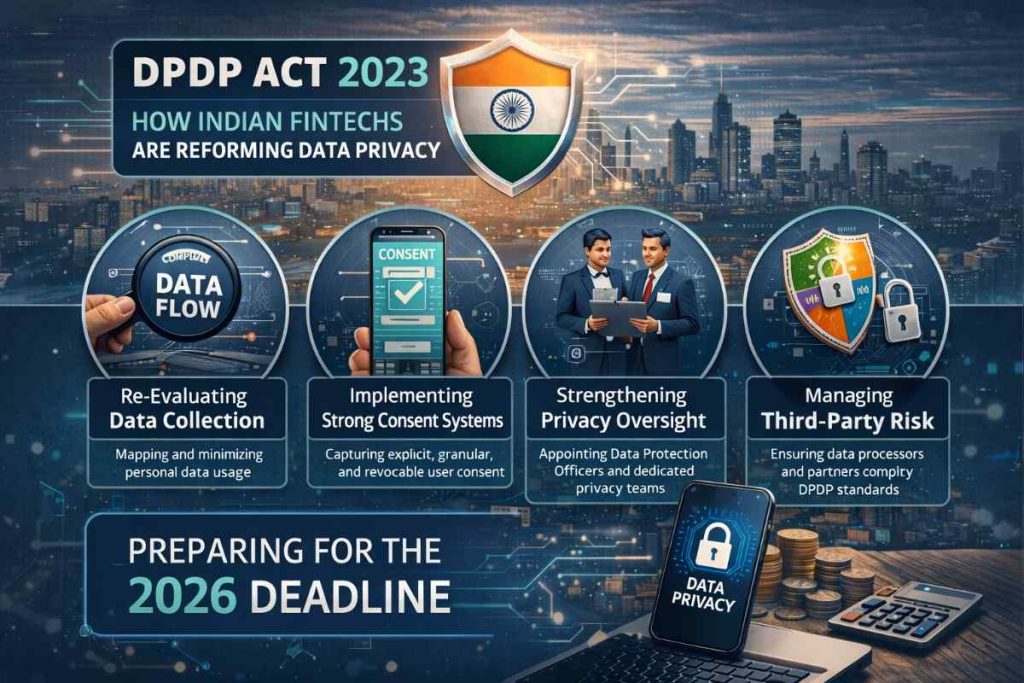
For fintech companies, the law is both a challenge and an opportunity. Digital lenders, wallets, investment platforms, and neo-banks are rethinking their operations to comply with strict new obligations. The phased rollout of the DPDP Act means that while full enforcement is scheduled for 2027, 2026 is the year when real change must occur. Companies are expected to implement consent mechanisms, operationalize privacy policies, and ensure that their entire data ecosystem is aligned with regulatory expectations.
Fintechs are conducting detailed audits to map every data flow within their platforms. These inventories help identify the types of personal data collected, the purposes for which it is used, and the duration of its retention. By embedding principles such as data minimization and purpose limitation into their systems, companies are ensuring that they collect only what is necessary and store it only as long as required. This re-engineering often extends to deleting outdated data automatically and segmenting databases to reduce risks.
Consent management has emerged as a cornerstone of compliance. The DPDP Act requires clear, informed, and revocable consent. Fintechs are redesigning onboarding journeys to capture granular consent for specific uses, maintaining detailed consent records, and creating dashboards that allow users to revoke permissions at any time. These initiatives not only meet legal obligations but also foster trust and transparency, reinforcing customer confidence in platforms where personal financial data is central to service delivery.
Beyond consent, fintech companies are strengthening governance frameworks. Data protection officers and dedicated privacy teams are becoming standard, ensuring that privacy considerations are embedded into product development, vendor management, and operational audits. Privacy is no longer a siloed concern for legal or IT departments—it has become a board-level priority.
Third-party partnerships, a critical component of fintech operations, are being scrutinized under the DPDP regime. Companies remain accountable for how vendors handle personal data, even when processing is outsourced. Contracts now include detailed privacy clauses, technical safeguards, and oversight mechanisms, while regular audits of vendors have become standard practice. This holistic approach minimizes risk across the ecosystem and ensures alignment with India’s evolving privacy standards.
Incident response and breach reporting have also received significant attention. Fintechs are establishing real-time monitoring systems and detailed playbooks for breach detection, assessment, and reporting. The DPDP Act mandates timely notification to both regulators and affected individuals, making preparedness essential. Non-compliance carries not just financial penalties but also reputational damage, which can be particularly costly in the competitive fintech sector.
While the DPDP Act imposes strict obligations, it also offers strategic advantages. Companies that embrace privacy as a core operational principle are building competitive differentiation. Users increasingly value platforms that handle their data transparently and securely, translating privacy compliance into customer loyalty. Moreover, systems designed with privacy in mind are often more robust, scalable, and resilient, giving compliant fintechs an edge in both domestic and international markets.
As the 2026 deadlines approach, Indian fintechs are demonstrating that privacy is not merely a regulatory checkbox but a strategic asset. By integrating the principles of the DPDP Act into their core operations, they are positioning themselves for long-term growth while setting new standards for trust and accountability in India’s digital economy. The transformation underway reflects a broader shift: in an era where data is the new currency, the companies that respect it the most may be the ones that thrive the longest.
Add startuptimes.in as preferred source on google – Click Here
Last Updated on Tuesday, January 27, 2026 10:20 am by Startup Times
About The Author