

India’s direct-to-consumer retail ecosystem is entering a decisive phase of digital maturity, and at the centre of this shift is generative artificial intelligence. What began as experimental automation in marketing and analytics has now evolved into a strategic lever that is redefining how Indian D2C brands design products, communicate with customers, manage supply chains, and scale profitably. In an environment marked by intense competition, rising customer acquisition costs, and increasingly discerning digital consumers, generative AI is no longer an optional innovation. It is fast becoming a core business capability.
Generative AI differs fundamentally from earlier waves of retail technology. While traditional AI focused on prediction and optimisation, generative systems are capable of creating new content, insights, and experiences by learning from vast volumes of data. For Indian D2C brands, this means the ability to generate personalised marketing copy, dynamic product descriptions, customer responses, design concepts, and demand forecasts at a speed and scale that was previously impossible. The impact of this capability is being felt across the retail value chain.
The timing of this shift is significant. India’s D2C sector has grown rapidly on the back of smartphone penetration, digital payments, social commerce, and logistics innovation. Consumers are now comfortable engaging with brands directly through apps, websites, and social platforms. At the same time, they expect relevance, speed, and personalisation as standard. Generative AI sits at the intersection of these expectations, allowing brands to move beyond one-size-fits-all experiences and towards truly individualised engagement.
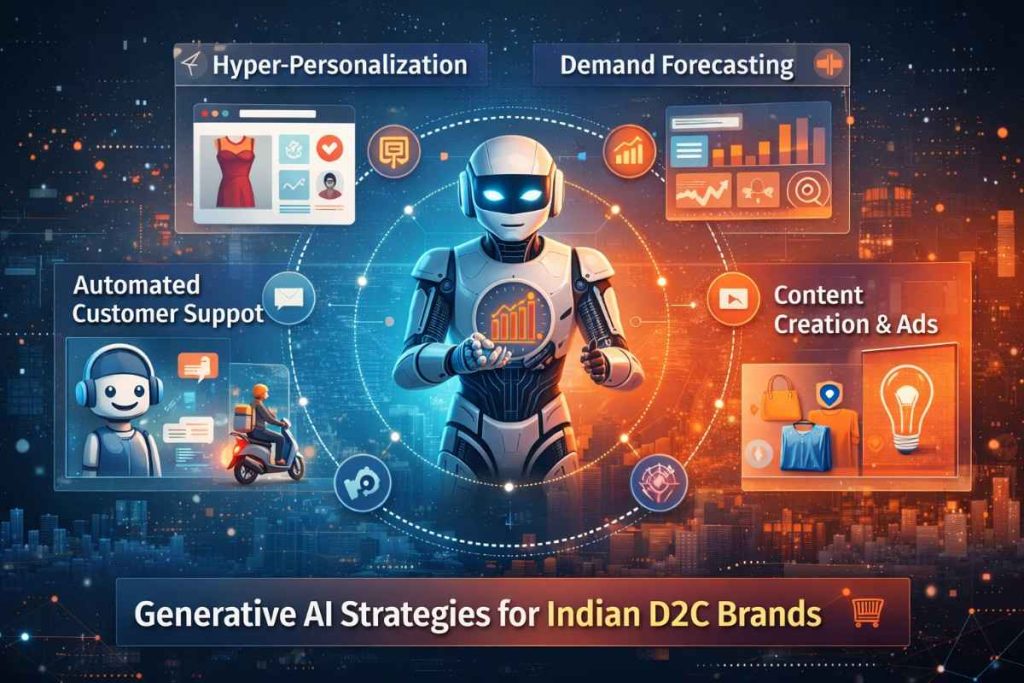
One of the most visible transformations driven by generative AI is in customer interaction and personalisation. Indian consumers today are exposed to thousands of brand messages every day, making attention a scarce commodity. Generative AI enables brands to tailor communication based on browsing behaviour, purchase history, regional preferences, and even language. Marketing messages, emails, app notifications, and website content can be dynamically generated to reflect individual customer interests, creating a sense of relevance that significantly improves engagement and conversion. In a diverse market like India, where cultural nuance and linguistic variation play a critical role, this level of personalisation is proving to be a powerful differentiator.
Beyond marketing, generative AI is reshaping customer support and product discovery. AI-powered conversational interfaces are increasingly capable of handling complex customer queries, recommending products, guiding size and fit decisions, and resolving post-purchase concerns. Unlike traditional rule-based chatbots, generative systems can understand context, adapt responses, and maintain conversational flow. For D2C brands operating at scale, this translates into round-the-clock support, reduced service costs, and more consistent customer experiences, without sacrificing quality.
Another area where generative AI is creating measurable impact is inventory planning and demand forecasting. Indian D2C brands often operate in fast-moving categories where demand can shift rapidly due to seasonality, social media trends, or influencer-driven spikes. Generative AI models can analyse historical sales data alongside external signals such as search trends, weather patterns, and promotional calendars to generate more accurate demand projections. This allows brands to reduce overstocking, minimise stockouts, and improve cash flow, a critical factor for young and growing businesses.
Marketing efficiency is also being transformed. Content creation has traditionally been a time-consuming and expensive process, particularly for brands that need to produce high volumes of creatives across platforms like Instagram, YouTube, marketplaces, and search engines. Generative AI is enabling faster creation of ad copy, social media posts, product visuals, and even video scripts, while maintaining brand consistency. This speed allows brands to test multiple campaign variations, respond quickly to market trends, and optimise performance in near real time, improving return on marketing investment.
Perhaps less visible, but equally important, is the role of generative AI in product innovation. By analysing customer reviews, feedback, and emerging trends, AI systems can surface unmet needs and suggest new product ideas or variations. For D2C brands that thrive on agility and rapid iteration, this capability shortens the cycle between consumer insight and product launch. In categories such as beauty, personal care, fashion, and food, where trends evolve quickly, generative AI is helping brands stay culturally and commercially relevant.
However, the adoption of generative AI in Indian retail is not without challenges. Many brands are still grappling with fragmented data systems, inconsistent data quality, and a shortage of skilled talent capable of managing AI-driven workflows. There are also growing concerns around data privacy, transparency, and responsible AI use, particularly as regulations around digital data protection become more stringent. Brands that fail to address these issues risk eroding consumer trust, which remains a critical asset in the D2C model.
As a result, leading D2C brands are approaching generative AI not as a standalone tool, but as part of a broader digital transformation strategy. Investments are being made in data infrastructure, governance frameworks, and cross-functional teams that combine technology expertise with marketing, operations, and customer experience. There is a growing recognition that while AI can automate and accelerate processes, human oversight remains essential to ensure authenticity, ethical use, and alignment with brand values.
Looking ahead, the role of generative AI in Indian D2C retail is set to deepen. As models become more accurate, multilingual, and context-aware, their ability to serve India’s diverse consumer base will only improve. Brands that successfully integrate generative AI into their core operations are likely to gain a lasting competitive advantage through better customer understanding, faster decision-making, and more resilient business models.
In a market as dynamic and demanding as India’s, generative AI represents more than a technological upgrade. It signals a shift in how D2C brands think about growth, customer relationships, and innovation. Those that embrace this shift thoughtfully and strategically are positioning themselves not just to survive, but to lead the next phase of India’s retail evolution.
Add startuptimes.in as preferred source on google – Click Here
Last Updated on Tuesday, February 3, 2026 7:02 pm by Startup Times
About The Author