

For much of the past decade, artificial intelligence in the enterprise was framed as a productivity enhancer rather than a structural force. Early deployments focused on assistance rather than execution, with AI tools acting as copilots that suggested content, summarized data, or automated isolated tasks. By 2026, that paradigm has decisively shifted. A new generation of native-AI SaaS startups is no longer building tools that sit on top of enterprise workflows; they are rebuilding those workflows from the ground up, fundamentally altering how organizations operate, make decisions, and scale.
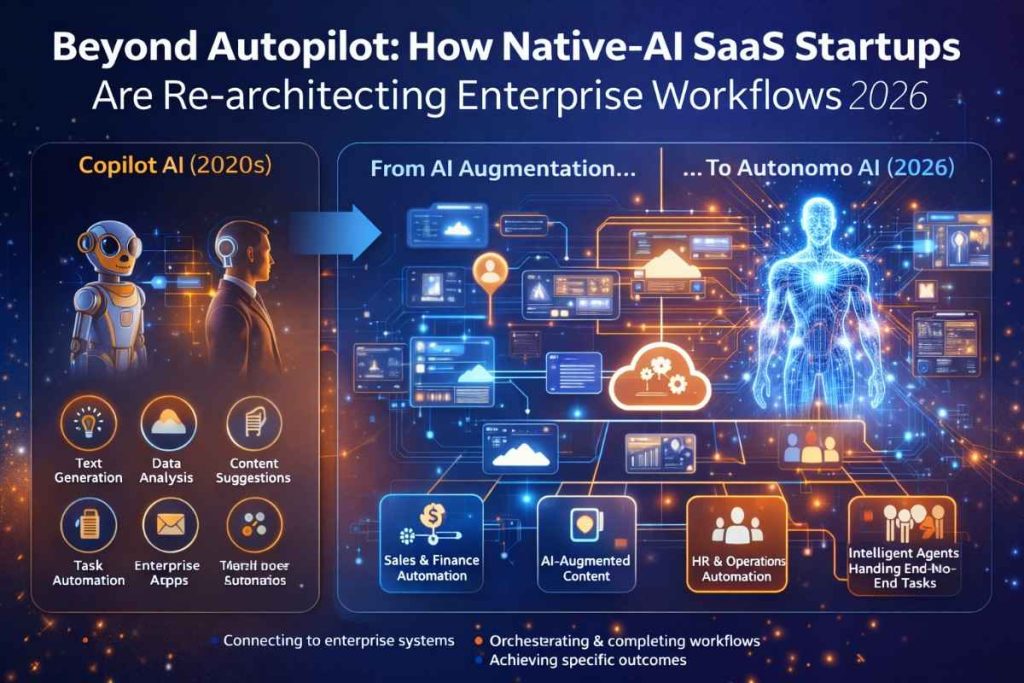
The defining feature of this transformation is the rise of AI systems that possess agency. Unlike earlier automation software that required constant human prompts and supervision, today’s native-AI platforms are designed to observe, reason, act, and learn within enterprise environments. These systems can trigger processes, coordinate across departments, interact with existing software infrastructure, and complete objectives end-to-end. The result is not incremental efficiency but a re-engineering of enterprise work itself.
This shift marks the end of what many executives now describe as the “autopilot era” of AI. Copilots helped individuals work faster, but they did not change how work was structured. Native-AI SaaS startups are taking a different approach. Their platforms treat workflows as living systems rather than static sequences, allowing AI agents to adapt dynamically to context, data changes, and business priorities. In sales, finance, operations, and customer support, AI is moving from suggestion to execution.
At the heart of this evolution is architecture. Traditional SaaS platforms were built as systems of record, optimized for storing data and enabling human interaction. Native-AI SaaS platforms, by contrast, are systems of action. They are designed around autonomous agents that can pull data from multiple sources, interpret signals, make decisions, and carry out tasks across tools that were previously siloed. This architectural shift enables enterprises to compress timelines dramatically, turning processes that once took days or weeks into real-time operations.
Enterprise leaders are increasingly viewing this transition as a necessity rather than an experiment. Years of AI pilot programs produced limited returns, often because the technology was bolted onto legacy systems without changing underlying processes. In 2026, organizations are prioritizing platforms that can operate at scale, integrate deeply with existing infrastructure, and deliver measurable outcomes. Native-AI startups have gained traction precisely because they were built for this reality, not retrofitted for it.
The implications for productivity are significant. In finance departments, AI agents are now handling document ingestion, compliance checks, and reporting cycles with minimal human input. In sales organizations, autonomous systems identify leads, personalize outreach, schedule follow-ups, and update customer relationship platforms automatically. In operations, AI agents monitor supply chains, detect anomalies, and trigger corrective actions before issues escalate. Human teams increasingly focus on oversight, strategy, and exception management rather than routine execution.
This transformation is also reshaping how enterprises measure return on investment. Instead of evaluating software based on feature adoption or license utilization, companies are assessing AI platforms based on outcomes delivered. Whether it is faster deal closure, reduced processing time, or improved customer satisfaction, the emphasis has shifted to business impact. This has encouraged a new commercial model in which vendors are expected to stand behind results, not just tools.
Yet the move toward autonomous enterprise systems is not without challenges. Trust remains a central concern, particularly as AI agents gain authority to act on behalf of organizations. Questions around accountability, governance, and transparency are becoming more urgent. Enterprises must determine how decisions made by AI systems are audited, how errors are detected, and how responsibility is assigned when outcomes fall short. In response, many native-AI SaaS platforms are embedding governance layers that allow humans to define boundaries, escalation protocols, and oversight mechanisms.
Cultural change is another hurdle. As AI systems take on more operational responsibility, roles within organizations are evolving. Employees are being asked to supervise intelligent systems, interpret outcomes, and apply judgment rather than execute predefined tasks. This shift requires new skills and a rethinking of performance metrics, particularly in industries that have long equated productivity with activity rather than impact.
Despite these challenges, momentum continues to build. Large enterprises, once cautious about granting autonomy to machines, are now deploying agentic AI in mission-critical environments. Established software vendors are responding by reworking their own platforms or acquiring AI-native startups to remain competitive. The enterprise software market in 2026 is increasingly defined by those who can orchestrate intelligence across workflows rather than simply store and display information.
Looking ahead, the rise of native-AI SaaS signals a broader redefinition of how organizations function. Workflows are becoming adaptive systems rather than fixed processes. Decision-making is increasingly distributed between humans and machines. Speed, resilience, and continuous learning are emerging as core competitive advantages. For enterprises willing to embrace this transformation, AI is no longer a support tool but a foundational layer of operations.
As the dust settles on years of experimentation, one conclusion is becoming clear. The future of enterprise software is not about adding intelligence to existing workflows. It is about rebuilding those workflows around intelligence itself. In 2026, the companies leading this shift are not merely adopting AI; they are redefining how work gets done in the modern enterprise.
Add startuptimes.in as preferred source on google – Click Here
Last Updated on Thursday, January 29, 2026 1:48 pm by Startup Times
About The Author

