
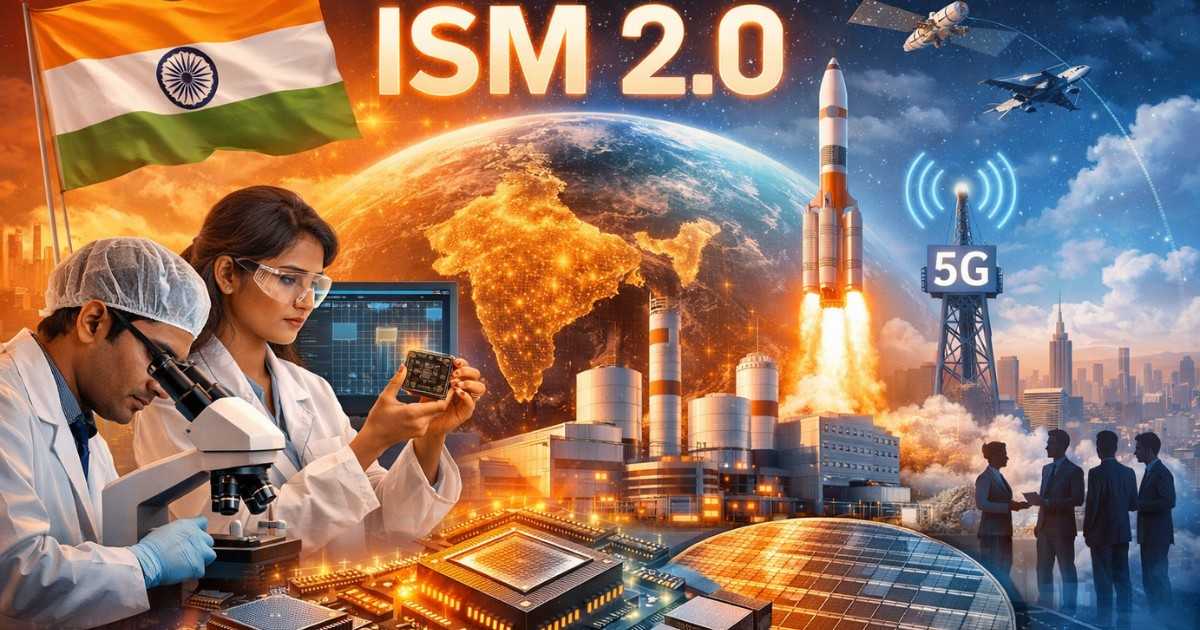
India’s semiconductor story is entering a decisive new chapter. After decades of being globally recognised as a powerhouse for software services and chip design outsourcing, the country is now making a deliberate, policy-backed transition toward building original semiconductor products. At the centre of this shift is India Semiconductor Mission 2.0 (ISM 2.0), a revamped national programme that aims to fund and nurture the next generation of nearly 50 indigenous semiconductor startups, transforming them from service providers into globally competitive product companies.
The first phase of the India Semiconductor Mission was largely about credibility and capacity. It focused on creating the foundational ecosystem — attracting fabrication investments, setting up packaging and testing units, and signalling to global players that India was serious about entering the semiconductor value chain. ISM 2.0, however, is different in both ambition and intent. It recognises that long-term competitiveness will not come merely from hosting fabs or assembling chips designed elsewhere, but from owning intellectual property, creating differentiated products, and exporting Indian-designed silicon to global markets.
This marks a strategic pivot in India’s technology narrative. For years, Indian engineers played a crucial but largely invisible role in global semiconductor companies, contributing to design, verification, and testing work while the ownership of products and profits remained overseas. ISM 2.0 seeks to reverse that equation by backing startups that design chips from scratch, develop proprietary architectures, and take responsibility for commercialization.
A key pillar of this transition is the expanded Design Linked Incentive framework under ISM 2.0. The earlier version of the scheme proved that there was no shortage of entrepreneurial ambition or technical talent. Dozens of young companies emerged across domains such as power electronics, communications, automotive chips, sensors, and industrial semiconductors. Many of them successfully completed tape-outs, validated designs with global foundries, and even secured early customers. ISM 2.0 builds on this momentum by widening the scope of funding, increasing financial support, and aligning incentives more closely with long-term revenue generation rather than short-term milestones.
What makes ISM 2.0 particularly significant is its emphasis on product thinking. Instead of encouraging startups to operate as design service vendors, the programme nudges them toward solving real-world problems through silicon. This includes chips for electric vehicles, renewable energy systems, 5G and future wireless networks, defence electronics, space applications, and edge artificial intelligence. These are sectors where India’s domestic demand is growing rapidly and where global supply chains are actively looking to diversify.
The funding model under ISM 2.0 reflects this maturity. Government support is designed to de-risk the most capital-intensive phases of semiconductor development, especially early-stage design, prototyping, and validation. At the same time, startups are encouraged to bring in private capital, ensuring that market discipline and commercial viability remain central to their growth strategies. This blended approach has already begun to attract venture capital and strategic investors who previously stayed away from semiconductor startups due to long gestation periods and high technical risk.
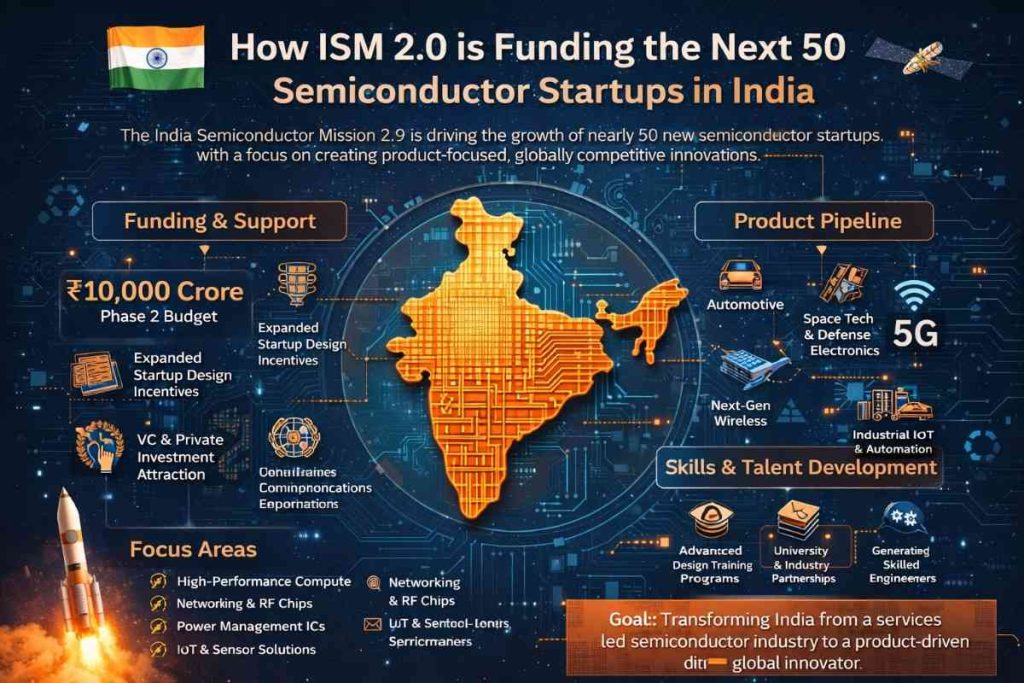
Beyond funding, ISM 2.0 also focuses on ecosystem depth. Semiconductor innovation does not happen in isolation, and the programme places strong emphasis on access to electronic design automation tools, shared infrastructure, fabrication partnerships, and advanced testing facilities. By lowering entry barriers, the mission enables smaller teams to compete in a space that was once dominated by large multinational corporations with deep pockets.
Talent development is another cornerstone of the initiative. India already hosts one of the largest pools of semiconductor design engineers in the world, but ISM 2.0 aims to move this talent up the value chain. Training programmes, academic collaborations, and industry partnerships are being aligned to ensure that engineers are not only skilled in design execution but also in system architecture, product definition, and manufacturing constraints. The goal is to create founders and leaders who understand the full lifecycle of a semiconductor product, from concept to customer.
The broader economic implications are substantial. Semiconductor products generate far greater value than services alone, creating high-quality jobs, export revenues, and strategic leverage. As geopolitical tensions reshape global supply chains, countries with strong domestic semiconductor capabilities are gaining both economic and national security advantages. ISM 2.0 positions India to be part of this new global order, not as a peripheral player, but as a contributor of original technology.
Challenges remain, and policymakers are aware of them. Semiconductor startups face long development cycles, high capital requirements, and intense global competition. Industry leaders have cautioned that policy flexibility, predictable timelines, and sustained support will be crucial for success. ISM 2.0 attempts to address these concerns by adopting a more consultative approach, refining incentive structures, and aligning public funding with market realities.
Ultimately, the success of ISM 2.0 will not be measured by the number of startups funded alone, but by how many of them evolve into globally relevant product companies. If even a fraction of the targeted 50 startups succeed in building scalable semiconductor products, the impact on India’s technology ecosystem could be transformative.
India’s journey from services to products in semiconductors will not be overnight, but ISM 2.0 signals that the direction is now firmly set. With policy support, private capital, and deep engineering talent coming together, the country is laying the groundwork for a future where “Designed in India” becomes as significant in semiconductors as it once did in software.
Add startuptimes.in as preferred source on google – Click Here
Last Updated on Friday, January 30, 2026 2:49 pm by Startup Times
About The Author