

India’s mid-market MSMEs are entering a more financially sophisticated phase of growth. After years in which equity funding was seen as the default route to expansion, a growing number of established small and medium enterprises are turning to strategic debt financing to fund scale, modernisation, and market expansion—without surrendering ownership or control.
This shift is not merely a response to a tighter equity funding environment. It reflects a deeper structural change in how MSMEs view capital, risk, and long-term value creation. As businesses mature, formalise operations, and achieve predictable cash flows, debt is increasingly being used as a precision instrument rather than a stopgap solution. For many founders, the goal is clear: fund growth while retaining strategic autonomy.
A key enabler of this transition has been the expansion of India’s MSME definition, which allows larger businesses to remain within the MSME framework even as they scale turnover and investment. This has widened access to institutional credit, priority-sector lending, and government-backed guarantee mechanisms for mid-sized firms that would previously have been pushed into the conventional corporate lending bracket. As a result, a new class of “mid-market MSMEs” has emerged—companies large enough to require sophisticated financing, yet nimble enough to benefit from MSME-focused policy support.
At the same time, equity has begun to feel more expensive for these businesses, not just financially but strategically. Equity capital brings permanent dilution, governance constraints, and long-term implications for control and succession. For MSMEs with stable revenues and visible order books, founders increasingly question whether it makes sense to dilute ownership to fund needs such as working capital, equipment purchases, or capacity expansion—areas where returns are measurable and time-bound.
Debt, when aligned with cash flows, offers an alternative that many now find more rational. The emphasis has shifted from borrowing capacity to borrowing design. Instead of asking how much they can raise, MSMEs are focusing on how capital is structured, how repayments align with operating cycles, and how leverage affects resilience during economic slowdowns.
Working capital financing remains the backbone of MSME borrowing, but its character is changing. Traditional overdraft-heavy models are giving way to receivables-linked financing that converts invoices into liquidity. Electronic receivables discounting systems and supply-chain finance arrangements are allowing MSMEs to unlock capital tied up in delayed payments without stretching balance sheets. The strategic advantage lies not only in access to funds, but in predictability—shortening cash cycles and reducing dependence on revolving debt.
For longer-term needs, such as machinery upgrades or plant expansion, term loans are being structured more carefully. Moratoriums during installation phases, step-up repayment schedules, and asset-backed lending models are increasingly common among mid-market borrowers with credible project plans. The focus is on ensuring that debt repayment coincides with revenue generation, rather than becoming a drag during early execution stages.
Credit guarantees have also played a crucial role in reshaping debt adoption. Enhancements to collateral-free lending frameworks and higher guarantee ceilings have encouraged lenders to extend credit to viable MSMEs without insisting on excessive security. While these schemes are often discussed in the context of smaller enterprises, their influence extends upward by improving overall lender confidence in the MSME segment and reducing risk premiums across loan portfolios.
More advanced MSMEs are also diversifying their lender base. Banks continue to anchor large facilities, but non-banking finance companies and co-lending structures are being used to plug specific gaps, particularly where underwriting is based on transaction data rather than static collateral. This diversification reduces concentration risk and gives businesses greater flexibility during refinancing or periods of volatility.
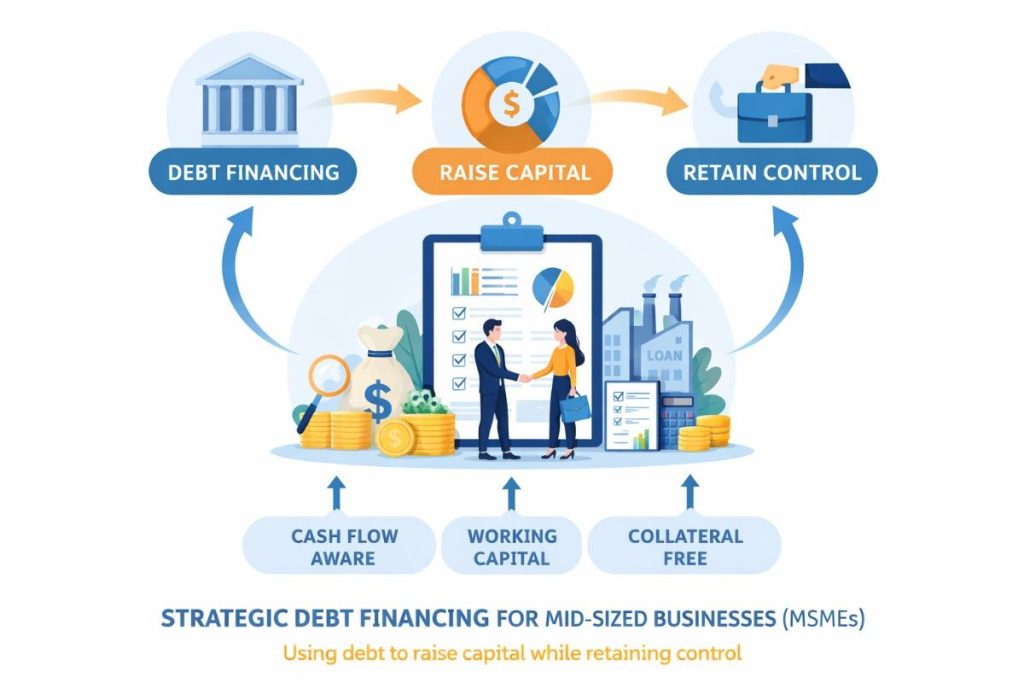
Crucially, optimisation has become the guiding principle. Strategic debt is not about maximising leverage, but about maintaining stability. Businesses are separating short-term working capital from long-term growth financing, monitoring debt service coverage more closely, and stress-testing their balance sheets against delays in receivables or cost shocks. Covenant awareness has improved, with MSMEs negotiating terms that reflect seasonality and operational realities rather than accepting rigid conditions that amplify risk.
There are, however, cautionary lessons. Debt that appears inexpensive on paper can become costly if repayment structures are misaligned or if short-term facilities are used to fund long-term assets. Rising interest rates and refinancing risk remain concerns, particularly for firms that rely heavily on floating-rate instruments. The more resilient MSMEs are those that maintain liquidity buffers and avoid excessive dependence on a single lender or product.
Digital adoption is accelerating this transition, though unevenly. While most MSMEs now accept digital payments, fewer have fully embraced digital lending platforms or data-driven credit products. This gap matters because the future of MSME debt lies in cash-flow-based underwriting, automated compliance, and faster credit decisions. As digital rails deepen, MSMEs that invest early in transparent financial systems are likely to enjoy lower borrowing costs and wider financing options.
By 2026, non-dilutive growth is no longer an abstract concept for India’s mid-market MSMEs. It is a practical strategy shaped by policy support, diversified lending ecosystems, and a more disciplined approach to capital structure. Debt is no longer viewed solely as a liability, but as a tool that, when used deliberately, can accelerate growth while preserving founder control.
The businesses that succeed in this environment will not be those that borrow the most, but those that borrow with intent—matching capital to cash flows, risk to return, and financing horizons to business reality. In doing so, mid-market MSMEs are quietly redefining how growth is funded in India’s next phase of economic expansion.
Add startuptimes.in as preferred source on google – Click Here
Last Updated on Thursday, February 5, 2026 10:43 am by Startup Times
About The Author

