

In today’s unpredictable market environment, early-stage startups in India and across the globe are facing unprecedented challenges in managing their finances. For companies operating at the forefront of innovation, the pressure to scale quickly while preserving cash has never been more acute. At the heart of this balancing act lies a critical metric that can determine a startup’s survival: burn rate.
Burn rate, which measures how quickly a startup consumes its cash reserves to cover operational expenses, serves as both a warning signal and a strategic compass. Startups often operate at a loss during their initial stages, investing heavily in product development, marketing, and talent acquisition in the hope of achieving rapid growth. However, in volatile market conditions, a high burn rate without a clear trajectory toward revenue can be fatal. The ability to accurately assess and control cash outflows is now a prerequisite for survival.
Investors are paying closer attention than ever to financial discipline. The era of “growth at all costs” is giving way to a more cautious approach, where venture capitalists and angel investors scrutinize startups’ financial strategies before committing funds. Founders are expected to demonstrate controlled growth, a clear understanding of unit economics, and a realistic projection of their runway. Those who fail to convey financial prudence often find themselves struggling to secure new funding rounds or maintain investor confidence.
Managing burn rate in such an environment requires a careful combination of foresight, operational efficiency, and adaptability. Startups are increasingly reevaluating spending priorities, ensuring that every expense contributes directly to growth or sustainability. They are also employing scenario planning, projecting cash flow under varying conditions to anticipate shortfalls and take preemptive action. Early monetization strategies are being explored to reduce dependence on external funding, and lean operational models are becoming the norm to stretch cash reserves further. Open communication with investors, suppliers, and service providers has also emerged as a vital strategy, allowing startups to negotiate more flexible terms and safeguard liquidity during uncertain times.
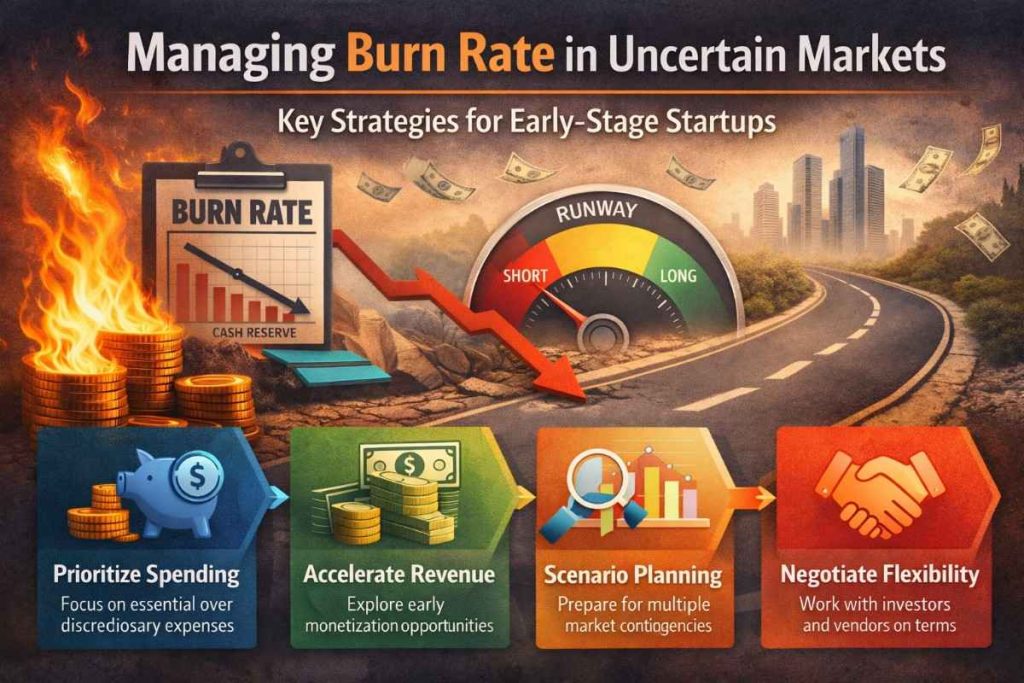
Closely monitoring key financial metrics provides founders with the insights necessary to make informed decisions. Metrics such as customer acquisition costs, lifetime value of customers, and recurring revenue not only guide spending but also signal efficiency to investors. Beyond numbers, cultivating a culture of accountability and transparency within the startup ensures that financial discipline permeates every level of the organization, reinforcing the link between spending and strategic objectives.
The current market volatility underscores the importance of resilience and adaptability. Startups that combine prudence with innovation, controlling their burn while pursuing growth, are better positioned to weather economic uncertainty and attract investor support. The lessons learned in managing burn rate during these turbulent times are likely to define the next generation of sustainable, high-impact companies. In a world where uncertainty is the only constant, mastering burn rate is not merely a financial necessity—it is a strategic imperative that can determine whether a startup thrives or falters.
Add startuptimes.in as preferred source on google – Click Here
Last Updated on Friday, January 23, 2026 3:11 pm by Startup Times
About The Author

