
In a startup ecosystem dominated by headlines of multi-million-dollar funding rounds and unicorn valuations, a quieter but equally compelling story is emerging — that of solo founders who have scaled their ventures to ₹100 crore in revenue without relying on external capital. These founders demonstrate that strategic focus, operational discipline, and relentless execution can sometimes outweigh the advantages of venture-backed growth.
Bootstrapping, the practice of building a business using internal resources and early revenues, offers founders complete control over decision-making and ownership. However, this independence comes with unique challenges. Without the safety net of investor funding, every business decision must be measured, and every rupee spent must contribute directly to growth or sustainability. Yet for those who succeed, bootstrapping becomes a validation of both the market and the founder’s strategy.
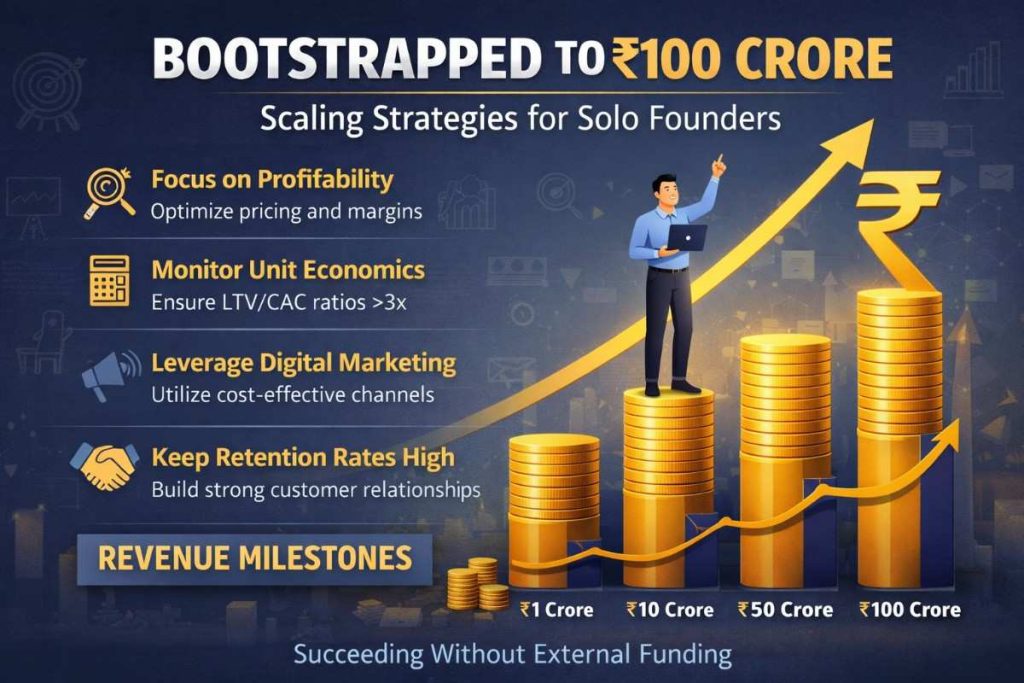
The journey from first sale to ₹100 crore in revenue is seldom linear. For most founders, the earliest milestone is proving that their product or service resonates with a paying customer. This phase demands focus on a niche audience, rapid iteration of the minimum viable product, and close attention to customer feedback. Successfully crossing this initial threshold signals product-market fit and sets the stage for repeatable sales.
Once early traction is established, founders shift attention to predictable revenue. Converting one-time buyers into loyal, recurring customers becomes crucial, as does standardizing offerings to streamline operations. Business processes begin to take shape, and investments in basic infrastructure such as customer management tools become necessary. It is during this phase that founders must balance the excitement of growth with the discipline of sustainable unit economics, carefully tracking costs and returns.
As revenues grow beyond ₹25 crore, the solo founder faces the challenge of systematizing operations. Delegation becomes essential, whether through hiring specialists or outsourcing specific functions. Standard operating procedures are established, and technology is deployed to maintain efficiency. Cash flow management becomes an ongoing concern, as the founder must fund expansion while ensuring operational stability.
Scaling to ₹100 crore requires not just operational efficiency, but strategic precision. Geographic expansion, diversification of revenue streams, and strategic partnerships are all tools leveraged at this stage. Brand building and thought leadership play a role in sustaining market visibility, while decision-making gradually shifts from hands-on management to guiding a growing team.
Despite these strategies, the path of a bootstrapped solo founder is not without obstacles. Limited bandwidth, absence of mentorship, and constrained cash flow often test endurance and creativity. Overcoming these hurdles requires prioritization, leveraging external expertise judiciously, and maintaining a constant focus on customer value and profitability. The mindset of endurance, patience, and adaptability often proves more important than any tactical advantage.
India’s startup landscape is beginning to recognize the importance of these self-funded success stories. Bootstrapped founders are redefining what it means to scale sustainably, proving that growth need not come at the expense of ownership, profitability, or operational discipline. Their journeys offer a roadmap for others who aim to build meaningful, resilient businesses without relying on venture capital.
In the end, reaching ₹100 crore is more than a financial milestone for a solo founder. It is a testament to the power of focus, discipline, and unwavering commitment to customer-centric growth. In a world obsessed with instant success, these bootstrapped entrepreneurs remind us that deliberate, sustainable progress often produces the most enduring results.
Add startuptimes.in as preferred source on google – Click Here
Last Updated on Monday, February 2, 2026 2:52 pm by Startup Times
About The Author