

For nearly a decade, India’s startup ecosystem sold a powerful narrative to young professionals: move fast, take risks, join a unicorn, and wealth creation would follow. ESOPs replaced job security. Hustle became a badge of honour. Founders were treated like celebrities.
Then the layoffs began.
What started as isolated cost-cutting exercises in late 2022 evolved into one of the most psychologically disruptive phases in India’s modern tech economy. Companies once celebrated for aggressive hiring — including Byju’s, Unacademy, ShareChat, and several venture-backed startups across fintech, edtech, social commerce, and SaaS — began downsizing at scale.
By 2023, layoffs had become normalised across India’s startup ecosystem. More than 100 Indian startups cut roughly 24,000 jobs during the year, according to data cited by TheKredible and reported by The Times of India.
The numbers mattered. But the deeper story was psychological.
The layoffs fundamentally altered how India’s tech workforce thinks about ambition, risk, loyalty, compensation, mental health, and career planning. A generation that once prioritised growth and startup prestige is increasingly valuing predictability, cash flow stability, and emotional safety.
This is not merely a hiring slowdown story. It is a workforce identity shift.
The Startup Boom Created a New Worker Mindset
Between 2015 and 2021, India’s startup ecosystem expanded rapidly, powered by low global interest rates, abundant venture capital, and pandemic-era digital acceleration.
The environment changed employee behaviour in several ways:
Risk Became Glamorous
Young engineers, marketers, designers, and product managers increasingly left established IT firms for startups promising rapid growth and ESOP upside. Traditional career ladders began to look outdated compared to the speed and visibility startups offered.
Working 12-hour days was often reframed as “ownership.” Burnout was normalised as ambition.
Job-Hopping Became a Career Strategy
Employees learned that switching startups every 12–18 months could significantly increase compensation. Venture funding created inflated hiring markets where talent wars pushed salaries upward.
For many professionals in Bengaluru, Hyderabad, Gurgaon, and Pune, startups became the fastest route to wealth accumulation and status mobility.
Founders Became Cultural Icons
India’s startup founders developed celebrity-like influence through podcasts, social media, LinkedIn, and venture media coverage. Startup culture itself became aspirational.
The implicit promise was clear: hypergrowth would continue indefinitely.
That assumption collapsed after the funding winter.
The Funding Slowdown Triggered a Psychological Shock
By late 2022, macroeconomic conditions changed globally. Rising interest rates, weaker venture capital activity, profitability pressure, and declining public tech valuations forced startups to prioritise survival over expansion.
The consequences were immediate.
Indian startups collectively laid off tens of thousands of workers between 2022 and 2024. Moneycontrol estimated that nearly 32,000 employees had been laid off since early 2022 across roughly 95 startups.
The layoffs were particularly severe in sectors that expanded aggressively during the pandemic:
- Edtech
- Social commerce
- Consumer internet
- Quick commerce
- Crypto
- Gaming
The psychological impact came not only from losing jobs, but from how suddenly narratives changed.
Employees who had been told they were “family” discovered that high-growth cultures could pivot quickly toward austerity.
The Collapse of Certainty
Perhaps the biggest shift was the disappearance of perceived certainty.
For years, startup workers believed several assumptions:
- Funding would always be available
- Growth would eventually compensate for losses
- ESOPs would become valuable
- High performers were relatively safe
- Brand-name startups guaranteed career security
Layoffs challenged all of them simultaneously.
At companies like Byju’s, the crisis became symbolic of a broader ecosystem correction. The company, once valued at $22 billion during the pandemic boom, later faced governance scrutiny, restructuring, delayed salaries, legal disputes, and valuation declines.
For employees across the startup ecosystem, these events changed how “startup success” itself was perceived.
Growth no longer automatically signalled stability.
Layoffs Changed Employee Behaviour Across the Industry
1. Stability Became Attractive Again
One of the clearest post-layoff shifts has been renewed interest in traditional employers.
Large IT services firms, global capability centres (GCCs), and mature product companies regained appeal because they offered:
- More predictable compensation
- Lower layoff volatility
- Structured career progression
- Better compliance and HR systems
In earlier years, many young professionals viewed such organisations as slower and less exciting. After repeated startup layoffs, stability began carrying social value again.
Recruiters increasingly report that candidates now ask detailed questions about:
- Cash runway
- Profitability
- Burn rate
- Funding dependency
- Business sustainability
Five years ago, such questions were relatively uncommon among junior employees.
2. ESOP Optimism Declined
The startup boom helped popularise ESOPs as wealth-building instruments. Employees often accepted lower fixed salaries in exchange for equity upside.
But layoffs exposed a difficult reality: paper wealth is highly uncertain.
When startups delayed IPOs, cut valuations, or struggled operationally, employee confidence in ESOP-driven compensation weakened considerably.
Workers increasingly began prioritising:
- Higher fixed salaries
- Emergency savings
- Liquid compensation
- Side income opportunities
The psychological preference shifted from speculative upside to immediate financial resilience.
3. “Hustle Culture” Lost Its Shine
The Indian startup ecosystem once celebrated relentless work intensity.
After layoffs, many employees started reassessing whether extreme work commitments actually produced long-term security.
The emotional contract between employers and workers weakened.
Employees who saw colleagues abruptly terminated despite strong performance became more sceptical of:
- performative culture slogans
- “family” narratives
- excessive loyalty expectations
- always-on work cultures
This does not mean ambition disappeared. But ambition became more transactional.
4. Silent Anxiety Became Widespread
One underreported consequence of the layoffs has been chronic workplace anxiety.
Even employees who retained jobs experienced:
- fear of sudden restructuring
- survivor’s guilt
- distrust toward leadership communication
- career uncertainty
- stress-driven productivity pressure
In many startups, repeated restructuring rounds created an atmosphere where employees constantly anticipated bad news.
The emotional effects extended beyond urban tech hubs. Many startup workers financially supported parents, siblings, or education loans. Sudden layoffs therefore affected entire family systems, not just individual careers.
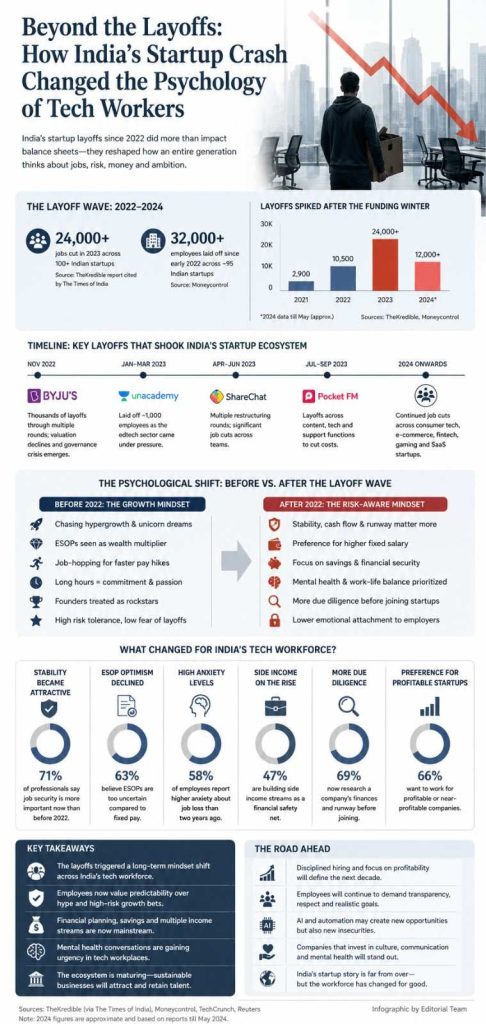
The Psychological Shift Is Especially Visible Among Younger Workers
For Gen Z and younger millennial employees, the layoffs disrupted their first major experience of corporate employment.
Many entered the workforce during the startup boom years and had never seen prolonged downturns before.
That has created several behavioural changes:
Career Diversification
Employees increasingly pursue:
- freelancing
- creator economy income
- consulting
- remote international work
- AI-assisted side businesses
Dependence on a single employer now feels riskier.
Lower Emotional Attachment to Employers
Employees are less likely to assume long-term reciprocity from startups. Job mobility remains high, but motivations are changing from ambition alone to defensive career planning.
Greater Financial Conservatism
Anecdotally, financial planners and recruiters report increased focus on:
- emergency funds
- insurance
- reduced discretionary spending
- avoiding lifestyle inflation
The startup generation is becoming financially more cautious.
India’s Startup Ecosystem Is Also Becoming More Mature
The layoffs were painful, but many investors and operators argue they also exposed structural weaknesses that had been ignored during the funding boom.
The correction forced startups to focus on:
- sustainable unit economics
- governance
- operational discipline
- profitability
- measured hiring
Several founders publicly acknowledged overhiring during the pandemic expansion phase.
At Unacademy, leadership explicitly linked layoffs to the need for leaner operations and profitability amid a tougher funding environment.
The broader ecosystem is now entering a more disciplined phase where scale alone is less celebrated than durable business models.
That evolution may ultimately produce healthier companies — but the workforce trust deficit remains real.
The Rise of the “Skeptical Employee”
Perhaps the most important long-term outcome is the emergence of a more skeptical tech employee in India.
Today’s startup workers are more likely to question:
- revenue quality
- founder credibility
- governance standards
- profitability timelines
- unrealistic growth projections
The emotional excitement surrounding startups has not disappeared entirely. India still produces globally competitive technology companies and continues attracting venture capital.
But blind optimism has faded.
The new workforce psychology is defined less by startup romanticism and more by calculated pragmatism.
What Happens Next?
India’s technology sector is unlikely to return fully to the hyper-euphoric hiring environment of 2021.
Instead, several long-term trends may define the next decade:
More Measured Hiring
Startups are expected to hire more cautiously, particularly in non-core functions.
Greater Employee Due Diligence
Candidates may increasingly evaluate startups like investors do — examining business fundamentals before joining.
Mental Health as a Workplace Issue
Layoff trauma and chronic uncertainty are likely to intensify conversations around burnout, anxiety, and emotional wellbeing in tech workplaces.
Stronger Preference for Profitable Businesses
Companies with sustainable cash flow may gain an advantage in attracting senior talent.
AI Could Add New Workforce Anxiety
Even as layoff fears moderate, automation and AI-driven efficiency could introduce a new layer of employment uncertainty across tech roles.
Conclusion
India’s startup layoffs did more than eliminate jobs. They dismantled an era of unquestioned optimism.
For years, the startup ecosystem taught employees to embrace speed, risk, and relentless ambition. The correction forced a reassessment of what modern career success actually means.
Today’s Indian tech workforce appears more cautious, financially aware, emotionally guarded, and strategically pragmatic than it was during the unicorn boom years.
That psychological shift may ultimately reshape not just hiring patterns, but the culture of Indian startups themselves.
The era of growth-at-all-costs changed companies.
The layoffs changed workers.
Also Read : The Great Indian SaaS Correction: Why Growth-at-All-Costs Is Quietly Dying
Add Startup Times as a preferred Source on Google – Click Here
Last Updated on Wednesday, May 20, 2026 4:15 pm by Startup Times
About The Author