

For nearly a decade, India’s software-as-a-service (SaaS) ecosystem operated on a simple premise: grow fast, capture market share, raise aggressively, and profitability could wait.
The formula worked — until it didn’t.
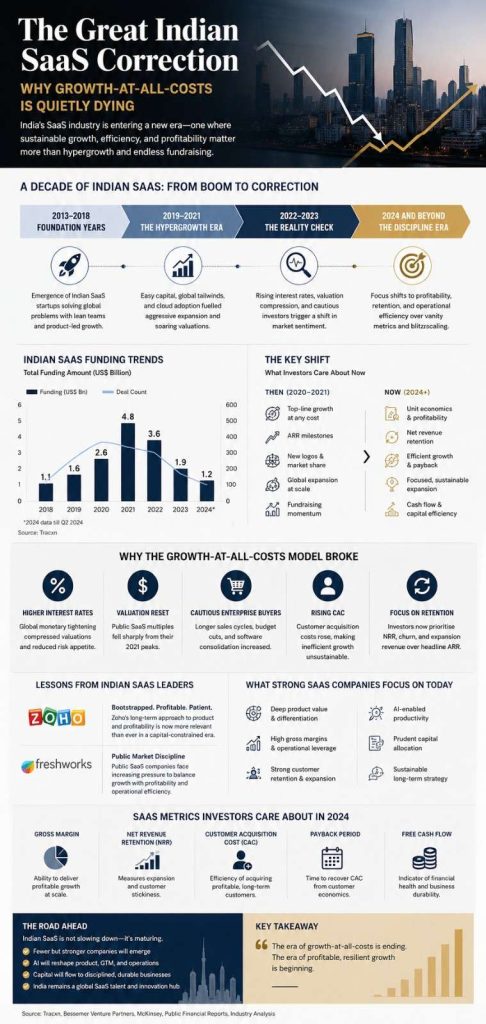
Between 2020 and 2022, abundant global liquidity, near-zero interest rates, and soaring cloud adoption pushed investors to reward rapid expansion above almost everything else. Indian SaaS startups raised record capital, expanded internationally at unprecedented speed, and hired aggressively to chase annual recurring revenue (ARR) milestones.
But by 2024, the mood had shifted sharply.
Funding slowed. Public SaaS multiples compressed globally. Enterprise customers tightened budgets. Investors began scrutinising burn rates instead of celebrating them. Startups that once marketed “triple-digit growth” as a badge of honour suddenly started discussing EBITDA discipline, net revenue retention, and cash efficiency.
What is unfolding now is not a collapse of Indian SaaS. It is a structural correction.
The “growth-at-all-costs” era is quietly giving way to a more mature operating model — one where sustainable economics matter as much as top-line expansion.
And for many founders, this may ultimately prove healthier for the ecosystem.
The Rise of India’s SaaS Boom
India’s SaaS industry emerged as one of the country’s most globally competitive technology sectors over the last decade.
According to estimates from Bessemer Venture Partners and McKinsey & Company, Indian SaaS companies crossed tens of billions of dollars in annual revenue collectively during the early 2020s, benefiting from:
- cloud infrastructure adoption
- lower software distribution costs
- global remote sales models
- rising enterprise digitisation
- India’s deep engineering talent pool
Companies such as Zoho, Freshworks, Postman, and Chargebee demonstrated that Indian startups could build globally relevant software businesses.
The success stories triggered a funding surge.
From 2020 onward, venture investors increasingly viewed SaaS as one of India’s strongest export-oriented technology opportunities. Companies were encouraged to prioritise speed over discipline. Hiring expanded rapidly. Sales teams ballooned. International market expansion became a default strategy rather than a calculated milestone.
The logic was straightforward: software markets reward scale, and the fastest companies often dominate categories.
But this strategy depended heavily on easy capital.
What Changed?
The Global SaaS Valuation Reset
The turning point came when global monetary conditions shifted.
As central banks, especially the US Federal Reserve, raised interest rates to combat inflation beginning in 2022, technology valuations globally came under pressure. Public SaaS companies that once traded at extremely high revenue multiples saw sharp corrections.
This had direct consequences for private markets.
Investors became significantly more cautious about:
- high cash burn
- long payback cycles
- weak unit economics
- excessive customer acquisition spending
- dependence on continuous fundraising
The benchmark metrics changed almost overnight.
Instead of rewarding “growth at any price,” investors increasingly prioritised:
- gross margins
- free cash flow
- retention quality
- operational efficiency
- sustainable expansion
Indian SaaS startups, deeply connected to global capital markets, could not escape this shift.
The End of Cheap Capital
One of the defining features of the previous SaaS boom was access to abundant venture funding.
Many startups operated under the assumption that future rounds would always be available if revenue growth remained strong. This encouraged aggressive spending across:
- marketing
- global sales
- recruitment
- expansion into multiple product categories
But venture capital slowed considerably after 2022.
According to multiple industry trackers, startup funding across India declined substantially from peak 2021 levels, with late-stage technology funding particularly affected.
This forced founders into difficult decisions:
- layoffs
- restructuring
- delayed expansion
- pricing corrections
- focus on profitable customer segments
Several SaaS startups quietly shifted internal targets away from pure ARR growth toward:
- runway extension
- cash preservation
- margin improvement
The language of boardrooms changed too.
“Efficient growth” replaced “blitzscaling.”
Why the Old SaaS Playbook Started Breaking
Customer Acquisition Became More Expensive
During the boom years, many SaaS companies assumed that rising customer acquisition costs (CAC) could be justified through future expansion revenue.
But enterprise buyers became more cautious after the global slowdown.
Sales cycles lengthened. Procurement scrutiny increased. Software consolidation accelerated as companies reduced overlapping subscriptions.
This created pressure on SaaS businesses that relied heavily on:
- expensive outbound sales
- aggressive discounting
- unsustainably low pricing
- rapid international expansion without strong retention
Companies that lacked strong product-market fit began facing serious stress.
Growth Without Retention Stopped Impressing Investors
The earlier market environment rewarded headline ARR growth even when retention metrics were weak.
That has changed.
Investors today increasingly focus on:
- net revenue retention (NRR)
- churn rates
- expansion revenue
- payback periods
- customer concentration risks
A SaaS company growing at 35–40% with strong retention and disciplined spending may now be viewed more favourably than a startup growing at 100% with unsustainable burn.
This represents a major philosophical shift in startup financing.
The Rise of the “Sustainable SaaS” Era
The correction is not entirely negative.
In fact, many experienced operators argue that the current environment is creating healthier businesses.
Product Depth Is Replacing Pure Growth Marketing
Founders are now being pushed to:
- build stronger products
- improve retention
- focus on customer outcomes
- reduce unnecessary expansion
- strengthen monetisation discipline
The emphasis is moving from vanity metrics toward durable value creation.
Companies with strong customer loyalty, high switching costs, and efficient operations are increasingly outperforming businesses dependent on constant fundraising.
AI Is Changing SaaS Economics
Artificial intelligence is also reshaping the SaaS landscape.
AI-native startups can automate workflows with smaller teams, potentially improving operational leverage. But AI is simultaneously intensifying competition by lowering software development barriers.
This creates a paradox:
- building software is becoming easier
- sustaining defensible SaaS businesses is becoming harder
As a result, investors are placing greater emphasis on:
- proprietary workflows
- distribution advantages
- customer trust
- ecosystem integration
- domain expertise
The days when generic SaaS products could raise large rounds solely on rapid user growth are fading.
Lessons From Indian SaaS Leaders
Zoho: The Long-Term Discipline Model
Long before profitability became fashionable again, Zoho operated with a capital-efficient philosophy.
The company avoided venture funding, expanded gradually, and focused heavily on product depth and sustainable economics.
During the funding boom, Zoho’s conservative approach sometimes appeared unfashionable compared to heavily funded rivals. But the current correction has revived interest in disciplined growth models.
Its strategy now appears increasingly aligned with the direction many SaaS startups are being forced toward.
Freshworks and Public Market Pressure
Freshworks’ public market journey also reflected broader SaaS market volatility.
Like many global SaaS firms, the company operated during a period when investors closely monitored profitability pathways alongside revenue expansion.
Public market SaaS companies globally now face significantly more pressure to demonstrate:
- margin discipline
- predictable growth
- operational efficiency
This dynamic is influencing private SaaS startups as well.
Why This Correction Could Benefit Indian SaaS Long-Term
Fewer “Tourist Founders,” More Durable Companies
Easy capital often attracts unsustainable business models.
The current environment is filtering out companies built primarily around fundraising momentum rather than strong fundamentals.
While painful in the short term, this may strengthen the ecosystem over time by encouraging:
- deeper product thinking
- stronger governance
- disciplined expansion
- realistic pricing
- sustainable customer acquisition
India Still Retains Structural Advantages
Despite the correction, India remains one of the world’s most promising SaaS ecosystems because of:
- lower engineering costs
- global talent availability
- increasing enterprise digitisation
- mature startup infrastructure
- growing founder experience
Indian SaaS companies continue to serve global customers across:
- fintech
- healthcare
- developer tools
- cybersecurity
- HR technology
- vertical SaaS
The opportunity has not disappeared.
What is changing is the operating philosophy.
The Future of Indian SaaS
Efficiency Will Become a Competitive Advantage
Over the next several years, the strongest SaaS companies are likely to prioritise:
- profitability pathways
- disciplined hiring
- retention-led growth
- AI-enabled efficiency
- focused product strategy
The ecosystem may also see:
- more mergers and acquisitions
- smaller but stronger funding rounds
- greater scrutiny on unit economics
- slower but healthier scaling
Importantly, investors are not abandoning SaaS altogether.
Rather, they are becoming more selective.
Capital is still available for startups demonstrating:
- durable product-market fit
- clear monetisation
- strong customer retention
- efficient growth models
Conclusion
The Indian SaaS ecosystem is not witnessing the end of growth.
It is witnessing the end of indiscriminate growth.
The previous decade rewarded speed above discipline because capital was abundant and global software demand was accelerating rapidly. But the post-2022 environment has forced a reassessment of what makes a durable software business.
The new winners in Indian SaaS may not necessarily be the loudest fundraisers or the fastest-growing startups. They are more likely to be companies that combine product quality, operational discipline, strong retention, and sustainable economics.
For founders, the message is becoming increasingly clear:
Growth still matters. But profitable, resilient growth matters far more.
Last Updated on Wednesday, May 20, 2026 4:49 pm by Startup Times
About The Author