
Swiggy has failed to secure the shareholder approval required to amend its Articles of Association (AoA), dealing a setback to the company’s effort to transition into an “Indian Owned and Controlled Company” (IOCC) under India’s foreign exchange regulations.
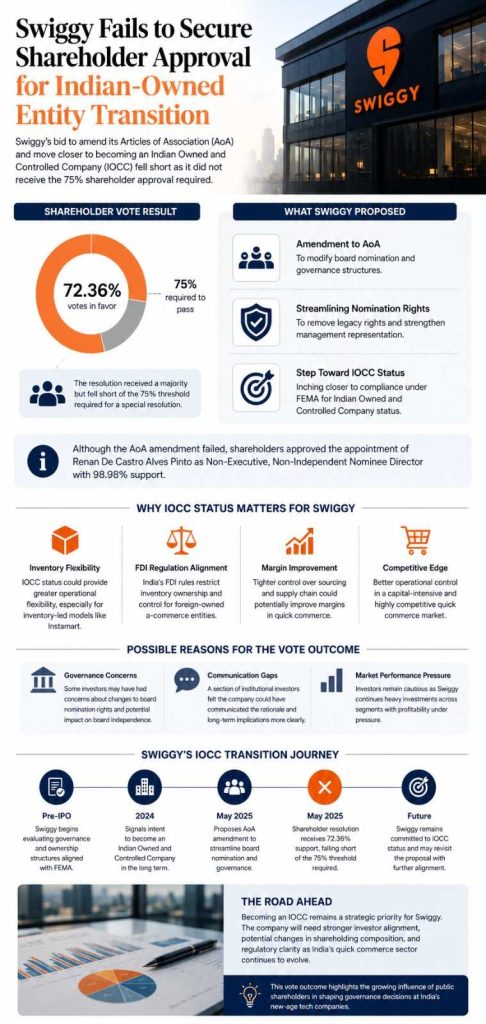
The special resolution received 72.36% shareholder support through a postal ballot process, falling short of the mandatory 75% threshold needed for passage under Indian corporate law. While the proposal secured a clear majority, the gap proved significant enough to halt one of the company’s most strategically important governance changes since its public listing.
The development comes at a crucial moment for Swiggy as the company expands aggressively in quick commerce through Instamart while simultaneously attempting to align its ownership and governance structure with India’s evolving foreign investment framework.
What Exactly Did Swiggy Propose?
Swiggy had sought shareholder approval to amend its Articles of Association to modify board nomination and governance structures. The changes were part of a broader effort to eventually qualify as an IOCC under India’s Foreign Exchange Management Act (FEMA) regulations.
Under FEMA rules, a company can qualify as Indian-owned and controlled only if both ownership and effective control rest with resident Indian citizens or Indian entities. Control is not determined merely by shareholding; it also includes board composition, voting rights, and governance mechanisms.
Swiggy clarified in earlier regulatory filings that the proposed amendments were aimed at streamlining “legacy nomination rights” and ensuring stronger management representation on the board as the company works toward long-term domestic control.
The company had also linked the move to a future scenario in which resident Indian shareholding crosses 50%, subject to regulatory and shareholder approvals.
Why IOCC Status Matters for Swiggy
The failed resolution is not merely a governance technicality. IOCC classification could materially impact how Swiggy operates key parts of its business, particularly quick commerce.
India’s foreign direct investment (FDI) rules impose restrictions on inventory-led ecommerce models for companies considered foreign-owned. Marketplace platforms are permitted, but inventory ownership and direct control over sellers face tighter regulatory scrutiny.
Swiggy’s effort to become an IOCC is widely seen as strategically tied to its quick commerce business, Instamart. Analysts and industry observers believe IOCC status could provide greater operational flexibility, including the ability to directly manage inventory procurement and supply chains more efficiently.
Quick commerce has emerged as one of the most capital-intensive and strategically important battlegrounds in India’s internet economy. Players including Zomato-owned Blinkit, Zepto, and Swiggy Instamart are aggressively investing in dark stores, logistics infrastructure, and private-label expansion.
For Swiggy, tighter control over sourcing and inventory could potentially improve margins over time in a segment where profitability remains under pressure.
Why Shareholders May Have Resisted
While Swiggy has not disclosed the detailed voting breakdown by shareholder category, reports indicate that some institutional investors were unconvinced by the proposed governance restructuring.
According to reports, several early backers and pre-IPO investors supported the resolution, but a section of public institutional shareholders voted against it.
There appear to have been three broad concerns among investors:
1. Governance and Board Independence
Changes to nomination rights and board structures often trigger concerns around corporate governance, especially in recently listed technology companies. Institutional investors typically scrutinize whether governance changes could dilute board independence or increase founder and management influence disproportionately.
2. Communication Gaps
Some investors reportedly felt Swiggy could have communicated the rationale and long-term implications of the restructuring more clearly before the vote.
Public market investors tend to demand significantly higher governance transparency compared to private market investors, especially when amendments involve control structures.
3. Market Performance and Execution Concerns
The vote also comes amid broader investor caution toward India’s consumer internet sector. Public market shareholders have become more selective about governance proposals as listed tech firms face mounting pressure to demonstrate sustainable profitability rather than pure growth.
Swiggy continues to invest heavily in Instamart and logistics expansion while competing aggressively across food delivery and quick commerce.
The Resolution That Did Pass
Although the AoA amendment failed, shareholders approved the appointment of Renan De Castro Alves Pinto as a Non-Executive, Non-Independent Nominee Director with 98.98% support.
However, Swiggy noted that certain proposed executive director appointments linked to the governance changes will no longer take effect due to the failure of the broader resolution.
This creates a more limited board restructuring than the company originally intended.
A Broader Trend Among Indian Internet Companies
Swiggy’s attempted transition reflects a larger structural shift underway in India’s startup ecosystem.
Many venture-backed internet companies that were originally funded heavily by global investors are now attempting to rebalance governance and ownership structures to align with Indian regulatory requirements. The motivation is particularly strong in sectors affected by ecommerce and FDI regulations.
Companies operating in food delivery, ecommerce, fintech, and quick commerce increasingly need governance flexibility as regulators pay closer attention to operational control, data localization, marketplace structures, and inventory ownership models.
The challenge, however, is that achieving IOCC status is structurally difficult for companies with substantial foreign shareholding and multiple international investors holding board or nomination rights.
For late-stage startups and listed technology firms, balancing global capital with domestic regulatory alignment is becoming a core governance issue rather than merely a legal formality.
What Happens Next?
Swiggy has indicated that becoming an IOCC remains a long-term strategic objective despite the failed vote.
The company is expected to continue engaging with shareholders and may revisit governance amendments in the future with revised proposals or greater investor consultation.
Whether Swiggy can eventually secure IOCC status will likely depend on three factors:
- Future changes in shareholding composition
- Stronger investor alignment on governance structures
- Regulatory clarity around quick commerce and inventory-led operations
For now, the setback highlights the increasing influence public shareholders wield over India’s newly listed technology companies.
Unlike the private funding era, where founders and major investors often controlled strategic decisions with limited resistance, public markets are demanding deeper accountability, clearer communication, and governance precision.
The Larger Significance for India’s Quick Commerce Sector
The outcome could also influence how other internet companies structure future governance transitions.
Quick commerce is rapidly evolving from a discount-driven growth business into an infrastructure-heavy retail model. As companies seek tighter supply-chain control and better unit economics, corporate structures and regulatory classifications are becoming strategically important.
Swiggy’s failed resolution underscores how governance architecture is now deeply intertwined with operational strategy in India’s startup economy.
The company’s inability to secure a relatively narrow margin of shareholder approval — missing the threshold by just 2.65 percentage points — also demonstrates that institutional investors are no longer passive observers in India’s consumer tech landscape.
Also Read : Lenskart Reports Strong Revenue Growth Despite Margin Pressure
Add Startup Times as a preferred Source on Google – Click Here
Last Updated on Friday, May 22, 2026 5:13 pm by Startup Times
About The Author