
Introduction
For years, Indian startups borrowed heavily from Silicon Valley’s hyper-growth playbook: raise aggressively, hire rapidly, add managerial layers, and scale teams faster than revenue. That model is now under pressure.
Across India’s startup ecosystem, founders are redesigning organizations around automation, artificial intelligence, workflow software, and lean execution teams. The biggest shift is not necessarily at the entry level. It is happening in the middle.
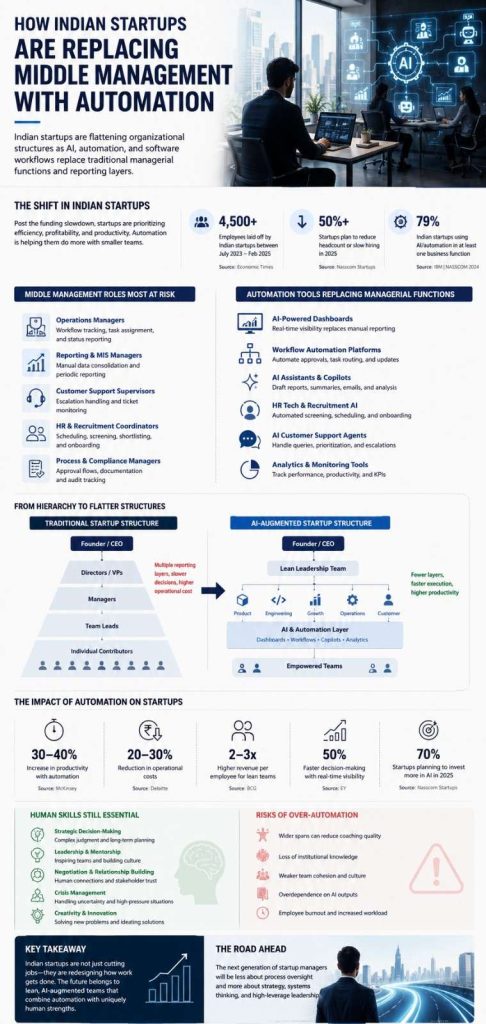
Operations managers, reporting coordinators, customer escalation supervisors, recruitment leads, and process-heavy managerial roles are increasingly being replaced — or significantly reduced — by automation systems and AI-enabled workflows.
The change is not merely about cost-cutting. It reflects a deeper structural transformation in how startups operate in a capital-constrained, AI-driven environment where investors are prioritizing profitability, productivity, and faster execution over workforce expansion.
While automation replacing repetitive tasks is not new, Indian startups are now applying it to managerial functions traditionally considered difficult to automate: monitoring performance, assigning workflows, generating reports, onboarding employees, handling internal approvals, and even supervising customer operations.
The result is a flatter organizational model where smaller teams manage larger outcomes with software acting as the coordination layer.
The End of the “Managerial Pyramid” Startup Model
During the funding boom between 2020 and 2022, many Indian startups expanded rapidly. Teams grew faster than operational maturity, creating multiple management layers designed to coordinate scaling businesses.
But the funding correction that followed forced founders to rethink organizational efficiency.
Investor conversations increasingly shifted toward:
- profitability,
- burn reduction,
- operational leverage,
- automation,
- and revenue per employee.
This has accelerated the adoption of lean organizational structures.
Several reports in 2025 and 2026 highlighted how Indian startups and IT firms were restructuring around AI-led productivity models. Industry reports noted growing layoffs and hiring slowdowns linked partly to automation and efficiency optimization.
The broader technology industry is also flattening management structures globally. Companies such as Meta and Amazon have publicly pursued leaner organizational models with fewer managerial layers.
Indian founders are following similar principles, though often for more survival-oriented reasons.
Why Middle Management Is Becoming Vulnerable
Middle management historically existed to solve coordination problems:
- assigning tasks,
- collecting updates,
- maintaining process compliance,
- escalating issues,
- monitoring productivity,
- and managing communication across departments.
Modern AI systems and SaaS platforms now automate many of these functions.
What Automation Is Replacing
Today’s startups increasingly use:
- AI-based project management tools,
- automated reporting dashboards,
- workflow orchestration software,
- AI copilots,
- HR automation systems,
- CRM-driven escalation management,
- AI customer support agents,
- automated recruitment screening,
- and analytics dashboards.
This means founders and senior leaders can access real-time operational visibility without relying on multiple reporting layers.
Functions most exposed include:
- operations coordination,
- customer support supervision,
- internal reporting management,
- routine HR administration,
- manual analytics consolidation,
- workflow monitoring,
- and approval-chain administration.
In many startups, dashboards now replace status meetings.
The Rise of the “AI-Augmented Team”
Rather than replacing entire departments, most startups are redesigning teams around AI-assisted productivity.
A growing number of companies are experimenting with:
- smaller execution pods,
- cross-functional operators,
- fewer managerial approvals,
- and AI-assisted decision-making.
Industry observers describe this as a shift from pyramid-shaped organizations to “diamond-shaped” or flatter workforce structures. An EY-linked industry analysis in 2025 noted that companies were redesigning workflows around hybrid human-AI operating models.
The implications are significant.
A team that previously required:
- a project manager,
- reporting analyst,
- operations lead,
- and coordination executive
can now operate with:
- a technical lead,
- AI-assisted workflows,
- and automated monitoring systems.
This dramatically changes the economics of scaling.
Indian Startups Are Prioritizing Productivity Per Employee
The startup ecosystem’s post-funding-reset era has fundamentally changed hiring behavior.
Between 2023 and 2026, venture capital firms increasingly pushed founders toward:
- sustainable growth,
- profitability,
- controlled hiring,
- and lean execution.
This has coincided with rapid adoption of generative AI tools.
Multiple industry reports during 2025 and 2026 showed Indian startups reducing hiring intensity while increasing investment in AI-enabled operations.
Some founders now openly discuss “revenue per employee” as a core operational metric.
The logic is straightforward:
- if AI tools allow 20 people to achieve what previously required 60,
- startups can preserve runway longer,
- improve margins,
- and reduce operational complexity.
This is especially relevant in sectors such as:
- SaaS,
- fintech,
- e-commerce,
- logistics,
- customer support,
- edtech,
- and D2C operations.
SaaS and IT Firms Are Leading the Shift
India’s SaaS and IT ecosystem is emerging as the clearest example of this transformation.
Several Indian IT firms have already begun restructuring delivery models around generative AI and automation. Reports in 2025 and 2026 showed hiring recalibration and reductions in certain mid-level managerial structures as AI-driven workflows improved productivity.
In software development environments:
- AI coding assistants reduce supervision overhead,
- automated testing tools shrink coordination requirements,
- and project visibility dashboards reduce reporting dependency.
As a result, engineering managers increasingly oversee larger teams with fewer intermediaries.
Some startups are also restructuring product and design teams around AI-assisted workflows:
- AI-generated prototypes,
- automated documentation,
- AI-based analytics summaries,
- and autonomous customer support systems.
This does not eliminate leadership roles entirely, but it changes the type of manager companies want.
What Startups Still Need Humans For
Despite the automation wave, startups are discovering important limitations.
AI systems remain weak at:
- organizational judgment,
- crisis management,
- negotiation,
- mentorship,
- cultural leadership,
- relationship-building,
- and strategic ambiguity.
Many founders now differentiate between:
- administrative managers,
- and decision-making leaders.
The first category is increasingly vulnerable.
The second is becoming more valuable.
This distinction matters.
A manager whose role depends primarily on forwarding updates, tracking workflows, and monitoring spreadsheets faces higher automation risk than one who:
- builds teams,
- resolves conflict,
- drives innovation,
- or handles complex customer relationships.
In practice, startups are not eliminating management altogether. They are eliminating low-leverage coordination layers.
The Hidden Risk: Losing Institutional Knowledge
Not everyone believes aggressive flattening is sustainable.
Global technology companies experimenting with AI-led restructuring have already faced concerns around burnout, reduced mentorship, and weakened organizational cohesion.
Several risks are emerging:
1. Wider Reporting Spans
Managers supervising too many employees may reduce coaching quality and employee development.
2. Knowledge Fragmentation
Automation systems cannot fully replace institutional memory and human context.
3. Cultural Erosion
Middle managers often maintain informal communication channels and team cohesion.
4. Overdependence on AI Outputs
AI-generated reports and analytics still require human interpretation and skepticism.
Many startup employees also report that AI tools improve productivity but increase review workloads and quality-control pressure. Discussions across developer communities reflect growing awareness that AI changes work structures more than it instantly replaces workers.
India’s Startup Workforce Is Being Redefined
The long-term impact may not simply be fewer jobs.
Instead, the ecosystem is moving toward different types of jobs.
Demand is increasingly shifting toward:
- AI-literate operators,
- product-minded engineers,
- automation architects,
- workflow designers,
- data analysts,
- and strategic generalists.
At the same time, purely coordination-based roles are weakening.
This could fundamentally reshape career ladders inside Indian startups.
Traditionally, employees moved from:
individual contributor → team lead → manager → senior manager.
Now, startups increasingly reward:
individual contributor → AI-augmented specialist → high-leverage operator.
The transition could especially affect MBA-heavy operational structures built during the startup boom years.
The Funding Environment Is Accelerating the Shift
The automation trend cannot be separated from venture capital dynamics.
In the easy-money era, headcount growth signaled ambition.
Today, efficiency signals discipline.
Investors now frequently ask:
- how much work can be automated,
- whether AI reduces operational dependency,
- and how quickly teams can scale without proportional hiring.
This has created a new startup narrative:
“small teams, large output.”
AI-native startups are taking this further by building organizations that intentionally avoid traditional middle-management structures from day one.
Instead of:
- large operations teams,
- layered reporting chains,
- and centralized coordination,
they rely on:
- automation-first workflows,
- integrated dashboards,
- and distributed decision-making.
Future Outlook: The Manager Is Not Disappearing — The Role Is Changing
The future of management inside Indian startups is unlikely to become fully automated.
But it will become narrower, more technical, and more outcome-focused.
The next generation of startup managers may need to function as:
- systems thinkers,
- AI workflow orchestrators,
- strategic decision-makers,
- and cultural leaders rather than administrative coordinators.
This transformation is still unfolding, and many companies are experimenting without clear long-term outcomes.
Some organizations may discover that removing too many human layers damages innovation and employee retention.
Others may successfully build highly productive AI-augmented companies with dramatically smaller teams.
What is clear is that the era of unlimited managerial expansion inside startups is ending.
Conclusion
Indian startups are not simply cutting jobs. They are redesigning organizational structures around automation, AI, and lean execution.
Middle management has become the pressure point because modern software increasingly handles the coordination tasks those roles once performed.
The shift reflects broader changes in:
- venture capital expectations,
- startup economics,
- AI adoption,
- and workforce productivity models.
Yet the transition remains incomplete.
The startups most likely to succeed will not necessarily be those that remove the most managers. They will be the ones that understand which human capabilities remain impossible to automate — and redesign organizations around that reality.
In the coming years, Indian startups may become smaller in headcount but significantly larger in output.
That could redefine not only startup operations, but the future of white-collar work in India itself.
Also Read : How Startup Layoffs Changed the Psychology of India’s Tech Workforce
Add Startup Times as a preferred Source on Google – Click Here
Last Updated on Wednesday, May 20, 2026 5:36 pm by Startup Times
About The Author