

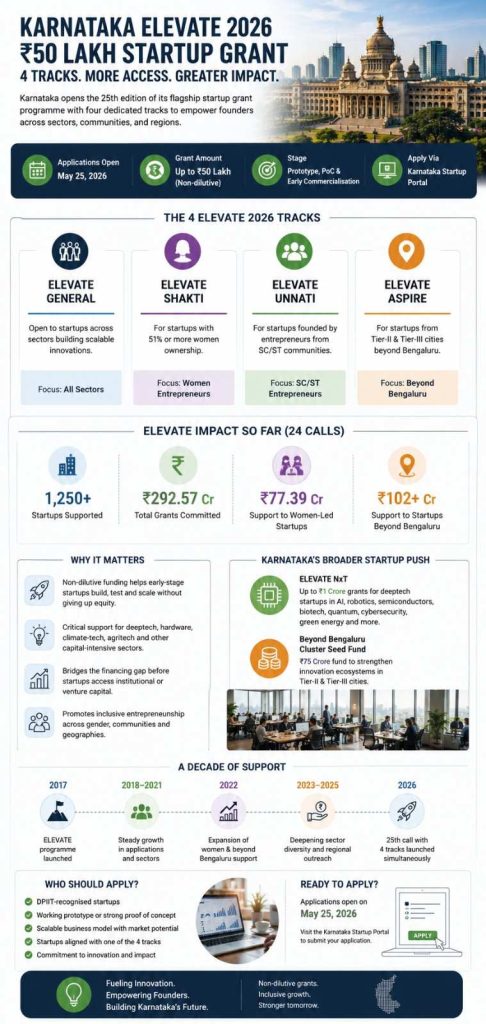
Karnataka has reopened applications for the 25th edition of its flagship startup support programme, ELEVATE, offering early-stage startups grants of up to ₹50 lakh under four simultaneous categories for the first time since the initiative began.
The Department of Electronics, IT, Biotechnology and Science & Technology announced that applications for the 2026 cycle will open on May 25 through the state’s official startup portal. The programme is designed to provide non-dilutive funding to startups at the prototype, proof-of-concept, and early commercialisation stages.
The latest edition marks a significant shift in how Karnataka is structuring state-backed startup support. Instead of operating isolated or phased categories, the government is running all four ELEVATE tracks simultaneously:
- ELEVATE General
- ELEVATE Shakti (women-led startups)
- ELEVATE Unnati (SC/ST founders)
- ELEVATE Aspire (Tier-II and Tier-III startups beyond Bengaluru)
The move reflects a broader policy push toward decentralised and inclusive entrepreneurship at a time when India’s startup ecosystem is increasingly concentrated around a handful of metro cities and venture-backed founders.
What Is Karnataka’s ELEVATE Programme?
Launched in 2017 under Karnataka’s startup ecosystem framework, ELEVATE is a grant-in-aid initiative intended to help early-stage startups build products before institutional investors become accessible.
Unlike venture capital, the grant is non-dilutive, meaning startups do not surrender equity in exchange for funding.
According to state government data cited in recent announcements, the programme has completed 24 calls over the past decade and supported more than 1,250 startups with approximately ₹292.57 crore in committed grants.
Women-led startups have reportedly received around ₹77.39 crore, while startups outside Bengaluru have secured over ₹102 crore in support.
Selected startups also receive access to:
- Mentorship networks
- Incubation support
- Government-linked Centres of Excellence (CoEs)
- Technology Business Incubators (TBIs)
- Patent and certification reimbursements under the Karnataka Startup Policy 2022–27
Why The 2026 Edition Matters
The 2026 call arrives during a period of visible transition in India’s startup financing environment.
While venture funding activity has improved from the sharp slowdown of 2023 and 2024, early-stage founders — especially outside Bengaluru, Mumbai, and Delhi NCR — continue to face limited access to institutional capital.
Government-backed grants have therefore become increasingly important for:
- Deeptech and hardware startups
- University spinouts
- Rural innovation ventures
- Climate-tech and agritech founders
- Women and underrepresented entrepreneurs
- First-time founders without investor networks
Karnataka’s decision to consolidate four tracks into one unified application cycle appears aimed at reducing fragmentation while expanding accessibility.
IT/BT Minister Priyank Kharge described the 25th call as an effort to make opportunities “more inclusive, accessible, and statewide,” according to official statements quoted by multiple publications.
Breaking Down The Four ELEVATE 2026 Tracks
1. ELEVATE General
This remains the core category open to startups across sectors.
Historically, Karnataka’s ELEVATE programme has seen participation from:
- SaaS startups
- Agritech ventures
- AI and machine learning firms
- Biotechnology startups
- Electronics and semiconductor ventures
- Clean energy companies
- Mobility and logistics startups
The General track is expected to remain highly competitive due to the breadth of eligible sectors.
2. ELEVATE Shakti
Formerly known as ELEVATE Women, this track is reserved for startups with at least 51% women ownership.
The renaming signals an attempt to reposition the category beyond symbolic diversity initiatives toward long-term founder participation.
The importance of women-focused startup funding remains substantial in India. Despite rising participation, women-founded startups continue to receive a disproportionately small share of venture capital funding nationally.
Government-backed grant programmes therefore play a critical role in helping founders reach product-market validation before institutional fundraising.
3. ELEVATE Unnati
This category targets startups founded by entrepreneurs from Scheduled Caste (SC) and Scheduled Tribe (ST) communities.
Access to early-stage risk capital in India remains heavily uneven across social and geographic lines. State-supported programmes such as Unnati aim to reduce those structural barriers by creating dedicated entry points into the innovation economy.
While many inclusion-focused startup initiatives exist on paper across Indian states, Karnataka’s ELEVATE programme stands out because of its relatively long operational history and publicly disclosed grant track record.
4. ELEVATE Aspire
Previously known as ELEVATE Beyond Bengaluru, Aspire focuses on startups emerging from Karnataka’s Tier-II and Tier-III cities.
This may ultimately become one of the most strategically important categories.
Bengaluru continues to dominate India’s startup landscape, but rising operational costs, talent saturation, and infrastructure constraints are pushing both founders and policymakers to explore distributed innovation clusters.
Cities such as Mysuru, Mangaluru, Hubballi-Dharwad, and Belagavi are increasingly being positioned as secondary startup ecosystems under Karnataka’s broader policy framework.
The Aspire track aligns with the state’s parallel “Beyond Bengaluru” initiatives and regional innovation funding efforts launched earlier this year.
Karnataka’s Larger Startup Policy Push
The ELEVATE expansion is not happening in isolation.
In January 2026, Karnataka also introduced ELEVATE NxT, a deeptech-focused programme offering grants of up to ₹1 crore for startups working in frontier technologies such as AI, robotics, semiconductors, quantum computing, biotech, cybersecurity, and green energy.
The state additionally announced a ₹75 crore Beyond Bengaluru Cluster Seed Fund aimed at strengthening regional startup ecosystems.
Together, these programmes suggest Karnataka is attempting to maintain its leadership position amid increasing competition from states such as Telangana, Tamil Nadu, Gujarat, and Maharashtra, all of which are expanding startup incentive frameworks.
Why Non-Dilutive Grants Matter More in 2026
The importance of programmes like ELEVATE has grown as India’s startup funding environment becomes more selective.
Over the past two years:
- Seed-stage venture rounds have taken longer to close
- Investors have prioritised profitability and efficiency
- Deeptech founders have struggled with long R&D cycles
- Hardware startups continue to face infrastructure and manufacturing barriers
For many founders, grants now serve as a bridge between ideation and institutional funding.
Unlike equity financing, government grants can help startups:
- Extend runway without dilution
- Build prototypes
- Conduct pilots
- File patents
- Achieve compliance certifications
- Generate initial market validation
This is particularly important for sectors where monetisation cycles are longer, including climate-tech, health-tech, biotech, semiconductors, and industrial AI.
The Challenges Founders Still Face
Despite its reputation, ELEVATE has also faced criticism from startup founders over the years.
Common concerns raised across founder communities and ecosystem discussions include:
- Long disbursement cycles
- Administrative complexity
- Documentation requirements
- Delayed reimbursements
- Limited transparency around evaluation timelines
Some founders have also argued that grant-based systems across India often favour startups already connected to incubators or ecosystem networks.
While Karnataka’s programme is generally considered among the more structured state-led startup initiatives, execution quality will remain critical as application volumes increase.
The simultaneous launch of four tracks could significantly expand participation, but it may also increase operational pressure on evaluators and disbursement systems.
Can Government Grants Replace Venture Capital?
Not entirely.
Programmes like ELEVATE are best viewed as ecosystem infrastructure rather than substitutes for private capital.
Most startups receiving grants will still require angel investment, venture capital, or strategic partnerships to scale meaningfully.
However, state-backed grants can play an important catalytic role by helping founders survive the highest-risk stage of company formation.
In India, where early-stage capital access remains uneven outside major startup hubs, that bridge funding can materially influence whether innovative ventures survive long enough to reach commercial viability.
What Startups Should Watch Before Applying
Founders considering ELEVATE 2026 should pay close attention to:
Eligibility Alignment
Applicants should ensure they clearly fit within one of the four categories and meet ownership or geographic criteria where applicable.
DPIIT Recognition
Government startup recognition and compliance documentation may significantly affect eligibility and evaluation readiness.
Prototype Readiness
Grant programmes increasingly prioritise startups with working prototypes or demonstrable problem statements rather than purely conceptual ideas.
Commercial Potential
Even non-dilutive grants are becoming more outcome-oriented, with evaluators looking at scalability, job creation, and innovation impact.
Governance and Compliance
Startups with weak incorporation structures or inconsistent documentation often struggle during government grant evaluation processes.
The Bigger Signal for India’s Startup Ecosystem
The broader significance of ELEVATE 2026 lies less in the ₹50 lakh headline figure and more in what it signals about the evolution of India’s innovation policy.
Over the last decade, India’s startup ecosystem has largely been shaped by private capital concentrated in urban technology hubs.
The next phase may depend more heavily on public infrastructure:
- state-backed incubation
- regional innovation clusters
- deeptech research funding
- university commercialisation
- non-dilutive capital support
- inclusive entrepreneurship programmes
Karnataka’s latest ELEVATE expansion suggests governments increasingly see startup policy not merely as branding, but as economic development infrastructure.
Whether these initiatives translate into globally competitive companies will depend on implementation quality, founder accessibility, and the ability to move beyond grant distribution toward long-term ecosystem building.
Also Read : Swiggy’s Push to Become an Indian-Owned Entity Faces Shareholder Setback
Add Startup Times as a preferred Source on Google – Click Here
Last Updated on Saturday, May 23, 2026 7:43 pm by Startup Times
About The Author