

For nearly three years, the global artificial intelligence conversation has revolved around a handful of companies building massive foundation models: OpenAI, Anthropic, Google DeepMind, Meta, and increasingly, Chinese AI labs backed by deep state and industrial capital.
India, despite being one of the world’s largest software talent hubs, has largely remained absent from that frontier-model race.
The country did not produce a ChatGPT-scale breakthrough. It does not yet control globally dominant GPU infrastructure. Its AI ecosystem still depends heavily on Western APIs and open-source ecosystems for production deployments.
Yet a different question is now beginning to shape investor discussions, startup strategy, and policy thinking:
Does India actually need to own foundational AI models to build globally relevant AI businesses?
An increasing number of founders, investors, and enterprise buyers believe the answer may be no — at least not immediately.
Instead of competing directly with trillion-dollar infrastructure companies, India’s emerging AI ecosystem is focusing on what it historically does best: product engineering, enterprise workflows, multilingual deployment, operational scale, and cost-efficient software delivery.
That shift could define India’s role in the global AI economy over the next decade.
India’s AI Ecosystem Is Growing — But It Is Structurally Different
India’s AI startup landscape has expanded rapidly since 2023, particularly across enterprise automation, customer support, voice AI, healthcare workflows, fintech operations, and agentic AI tools.
But the ecosystem remains heavily application-layer driven.
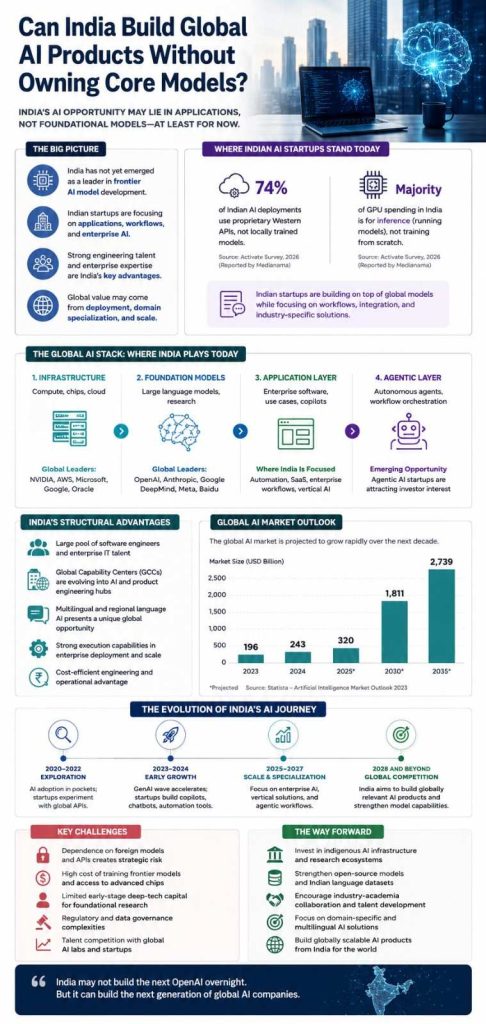
A 2026 survey by venture firm Activate found that roughly 74% of Indian AI deployments relied on proprietary Western APIs rather than locally trained models. Only a small minority of startups were training or meaningfully customizing their own foundation models.
The same report found that most GPU spending in India goes toward inference — running AI systems — rather than training large-scale models from scratch.
That distinction matters.
Training frontier AI models requires:
- massive compute infrastructure
- proprietary datasets
- advanced research talent
- long-term capital
- specialized chips
- high-risk experimentation cycles
Those advantages are concentrated in the United States and increasingly China.
India, by contrast, built its technology reputation through IT services, SaaS, enterprise integration, and scalable engineering execution — not frontier scientific research.
That reality is now shaping the country’s AI strategy.
India May Have Missed the Infrastructure Layer
Many investors privately acknowledge that India largely missed the first wave of the generative AI boom.
The foundational layer — GPUs, hyperscale infrastructure, frontier models, and AI cloud ecosystems — became dominated by American firms with access to extraordinary amounts of capital and compute.
According to a 2026 Business Standard analysis, Indian startups are now pivoting toward AI applications and enterprise workflows after largely missing the infrastructure cycle.
That shift is not necessarily a weakness.
Historically, technology value creation often migrates upward:
- infrastructure becomes commoditized
- platforms stabilize
- application ecosystems expand
- distribution and workflow ownership gain value
The smartphone economy followed a similar trajectory. Few companies built mobile operating systems, but thousands built valuable businesses on top of them.
The AI market may evolve similarly.
The “AI Wrapper” Criticism Is Becoming More Nuanced
One of the biggest criticisms facing Indian AI startups has been the rise of so-called “AI wrappers” — products that rely heavily on existing models from OpenAI or Anthropic while adding minimal differentiation.
That criticism is partially valid.
But it is also increasingly oversimplified.
Modern enterprise AI products are rarely just thin interfaces over APIs. The real complexity often lies elsewhere:
- workflow integration
- proprietary enterprise data
- domain-specific reasoning
- orchestration layers
- compliance systems
- retrieval architectures
- multilingual deployment
- reliability engineering
- industry customization
In many enterprise environments, the model itself is only one component of the product stack.
Google and Accel’s 2026 AI accelerator in India reportedly rejected a large number of superficial AI-wrapper startups while backing companies building workflow-native AI systems across life sciences, ERP automation, industrial manufacturing, and enterprise agents.
That distinction is important.
The next generation of AI companies may not win because they own the largest model. They may win because they own the most valuable workflow.
India’s Real Advantage May Be Enterprise AI
India’s strongest AI opportunity currently appears to be enterprise adoption rather than frontier research.
Several structural factors support this:
1. Deep Enterprise Engineering Talent
India already operates one of the world’s largest pools of software engineers, IT services professionals, and enterprise implementation specialists.
As AI adoption moves from experimentation to operational deployment, implementation complexity becomes critical.
That benefits ecosystems with strong integration capabilities.
2. Global Capability Centers Are Becoming AI Labs
India’s GCC ecosystem is evolving rapidly.
Companies like Workday and Daimler Truck are increasingly expanding AI-related engineering work in India, not merely back-office support.
Reuters recently reported that Indian engineering hubs are contributing more directly to IP generation and AI-driven product development.
That transition matters because it gradually shifts India from outsourced execution toward higher-value technical ownership.
3. AI Deployment May Matter More Than AI Research
Many businesses do not necessarily need state-of-the-art frontier models.
They need:
- reliable AI copilots
- automation systems
- multilingual interfaces
- cost-efficient inference
- secure enterprise deployment
- domain-specific workflows
India’s engineering ecosystem is well-positioned to solve those operational problems at scale.
Why India’s Multilingual Challenge Could Become an Advantage
One area where India could create differentiated AI products is language infrastructure.
Global AI systems still struggle with many Indian languages, dialects, and context-heavy conversational patterns.
This creates opportunities for Indian startups building:
- Indic language models
- voice AI systems
- regional enterprise interfaces
- low-cost on-device inference
- government-service AI infrastructure
Companies such as Sarvam AI are attempting to build indigenous multilingual AI systems optimized for Indian datasets and local languages.
The broader IndiaAI Mission is also attempting to support domestic model development, including subsidized compute access and sovereign AI initiatives.
Whether these efforts can compete globally remains uncertain.
But they may not need to replicate OpenAI-scale capabilities to become strategically important.
The Missing Piece: Ownership of the Core Intelligence Layer
Despite optimism around applications, India still faces a long-term strategic question.
If foundational models increasingly control:
- pricing
- inference economics
- distribution
- API access
- ecosystem standards
- AI capabilities
then countries without core model ownership may remain structurally dependent.
This concern is becoming more serious as AI systems become vertically integrated.
A startup built entirely on external APIs carries several risks:
- margin compression
- dependency on foreign providers
- sudden pricing changes
- regulatory vulnerability
- limited defensibility
- restricted customization
This is why some investors argue India cannot permanently avoid foundational AI investment.
The challenge is economic.
Training cutting-edge frontier models now requires billions of dollars in capital expenditure, advanced semiconductors, and research ecosystems that India is still developing.
Even Europe has struggled to compete at the frontier despite stronger research infrastructure.
Open Source Could Change the Equation
One factor reshaping the debate is open-source AI.
As open-weight models improve, startups no longer need to build frontier models entirely from scratch to create valuable products.
Instead, they can:
- fine-tune open models
- optimize smaller models
- build proprietary datasets
- specialize for domains
- improve orchestration systems
- reduce inference costs
This potentially lowers the barriers for ecosystems like India.
Several Indian startups are now experimenting with smaller domain-specific models and agentic architectures rather than trying to replicate GPT-scale systems directly.
The rise of smaller specialized models could favor engineering-heavy ecosystems over pure research-heavy ecosystems.
Agentic AI May Be India’s Next Big Opportunity
A growing share of Indian AI investment is now moving toward agentic AI — systems that perform actions autonomously rather than simply generating text.
Indian startups in this category are attracting increasing investor interest.
This matters because agentic AI shifts value toward:
- workflow execution
- system orchestration
- enterprise integration
- operational automation
Those are areas where India already has decades of software experience.
If foundation models become increasingly commoditized, the strategic value could migrate toward the orchestration layer — the systems coordinating enterprise workflows, data access, compliance, and execution.
India may be better positioned for that layer than for the frontier-model race itself.
The Risk of Becoming Permanently Dependent
Still, the dependency problem remains unresolved.
If India becomes only an “AI implementation economy,” it risks repeating a familiar pattern:
- strong services exports
- limited platform ownership
- low infrastructure control
- reduced pricing power
That concern increasingly shapes policy discussions around sovereign AI.
The Indian government’s IndiaAI Mission is partly designed to prevent long-term dependency on foreign AI infrastructure.
However, building globally competitive foundational AI ecosystems requires more than government announcements.
It demands:
- research universities
- semiconductor ecosystems
- patient deep-tech capital
- frontier scientific culture
- large-scale compute access
- globally competitive compensation structures
Those systems take years — sometimes decades — to mature.
The Most Likely Scenario: India Builds Hybrid AI Strengths
The most realistic outcome may not be binary.
India may not dominate frontier AI models in the near term.
But it could still build globally relevant AI companies by combining:
- open-source ecosystems
- domain specialization
- multilingual intelligence
- enterprise deployment
- cost-efficient engineering
- agentic workflows
- vertical AI products
This would resemble how India succeeded in SaaS:
not necessarily by inventing core internet infrastructure, but by building globally scalable software businesses on top of it.
The difference is that AI dependency carries deeper strategic implications than traditional cloud software.
That means India’s long-term AI success will likely require both:
- strong application-layer innovation
- gradual investment in indigenous model capabilities
Conclusion
India’s AI future may not look like Silicon Valley’s.
The country is unlikely to outspend American hyperscalers or match China’s state-backed compute scale in the immediate future.
But the AI economy is no longer just about building the largest model.
As enterprises shift from experimentation to deployment, value may increasingly move toward:
- workflow integration
- vertical specialization
- multilingual systems
- operational AI
- enterprise automation
- agentic software
Those are areas where India already possesses structural advantages.
The bigger challenge is strategic balance.
If India focuses only on applications, it risks long-term dependence on foreign intelligence infrastructure.
If it focuses only on foundational models, it may struggle against vastly larger incumbents.
The most sustainable path may lie somewhere in between:
building globally competitive AI products today while steadily developing indigenous AI capabilities for the future.
That may not produce the next OpenAI overnight.
But it could still produce the next generation of globally important AI companies.
Also Read : Karnataka Opens ELEVATE 2026 With ₹50 Lakh Startup Grants Across Four Tracks
Add Startup Times as a preferred Source on Google – Click Here
Last Updated on Monday, May 25, 2026 2:34 pm by Startup Times
About The Author