
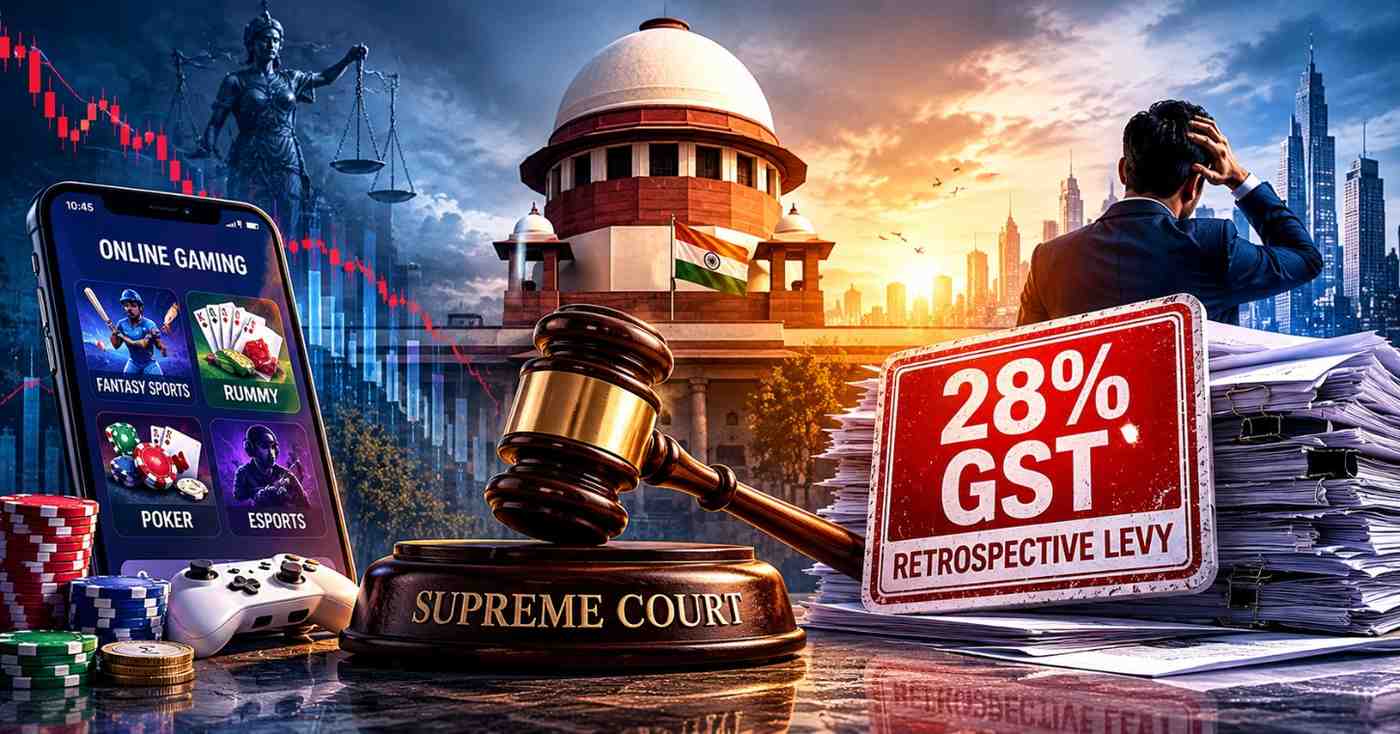
India’s online gaming industry is confronting its most consequential regulatory setback yet.
In a landmark judgment delivered on May 27, 2026, the Supreme Court upheld the government’s retrospective levy of 28% Goods and Services Tax (GST) on online gaming companies, validating a position that tax authorities have aggressively pursued for years. The ruling effectively revives tax demands running into an estimated ₹2.5 lakh crore across the industry and could fundamentally alter the economics of India’s real-money gaming sector.
For founders, investors, and policymakers, the judgment is more than a tax dispute. It is a defining moment for one of India’s fastest-growing digital industries—one that attracted billions in venture capital, created thousands of jobs, and positioned itself as a key pillar of the country’s consumer internet economy.
The verdict also raises broader questions about regulatory certainty, retrospective taxation, and the future of digital businesses operating in legal grey areas.
What Did the Supreme Court Rule?
A bench comprising Justices J.B. Pardiwala and R. Mahadevan upheld the constitutional validity of the government’s retrospective GST framework for online gaming.
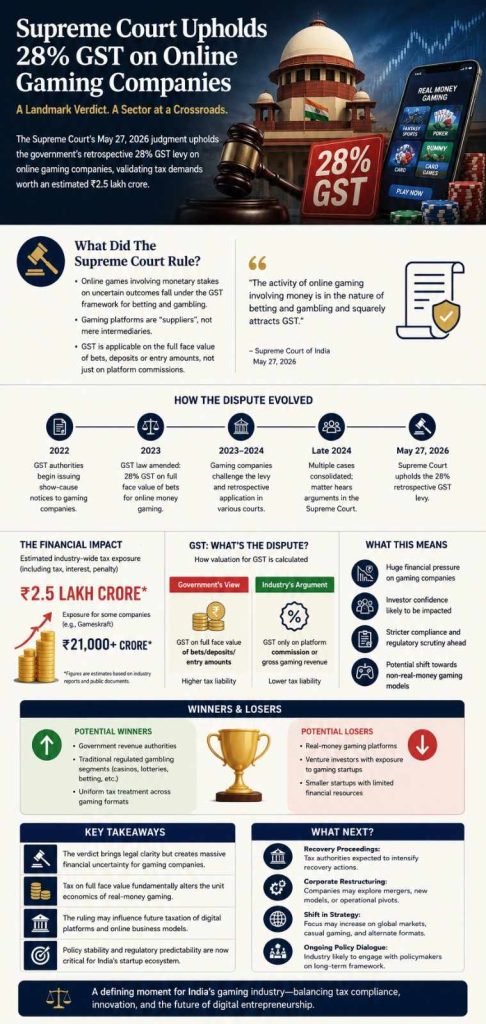
The court held that online gaming platforms involving monetary stakes on uncertain outcomes fall within the GST framework applicable to betting and gambling activities. It further observed that gaming operators are not merely intermediaries facilitating transactions between users but are suppliers of actionable claims subject to GST.
One of the most consequential aspects of the judgment is its endorsement of GST being levied on the full face value of bets, deposits, or contest entry amounts rather than only on the platform’s commission or gross gaming revenue (GGR).
This distinction lies at the heart of the dispute.
For years, many gaming companies argued that GST should apply only to the platform fee they retained, not to the entire amount deposited or staked by users. Tax authorities took the opposite view, asserting that the entire pool constituted a taxable value.
The Supreme Court has now sided with the government.
How the Industry Reached This Point
The dispute did not emerge overnight.
India’s online gaming industry expanded rapidly during the last decade, driven by fantasy sports, rummy, poker, esports-adjacent platforms, and skill-based gaming applications.
Several startups, including major fantasy sports and real-money gaming operators, built businesses around legal precedents that distinguished “games of skill” from gambling. Earlier court decisions in India had repeatedly recognized certain formats such as fantasy sports and rummy as skill-based activities under specific circumstances.
However, the GST debate evolved separately from gambling law.
Beginning in 2022 and accelerating through 2023, the Directorate General of GST Intelligence (DGGI) issued a series of massive show-cause notices to gaming companies, alleging tax shortfalls. Some notices individually ran into tens of thousands of crores. The most prominent among them included a GST demand exceeding ₹21,000 crore against Gameskraft.
The government subsequently amended GST laws in 2023, introducing explicit definitions for online money gaming and imposing a 28% GST on the full face value of bets or deposits. Gaming companies challenged both the retrospective application and the valuation methodology.
The Supreme Court’s latest judgment effectively closes a significant chapter in that legal battle.
Why the Verdict Matters Beyond Gaming
The immediate impact is obvious: substantial tax exposure for gaming companies.
But the ruling’s implications extend far beyond a single industry.
1. Regulatory Certainty Comes Under Scrutiny
Investors typically view retrospective taxation as one of the highest forms of regulatory risk.
When companies make business decisions based on prevailing interpretations of law and later face large historical tax demands, confidence in policy predictability can erode.
Several venture capital funds, private equity investors, and international gaming operators have invested heavily in India’s gaming ecosystem over the past decade. The verdict may prompt investors to reassess regulatory risks in sectors where legal interpretations remain fluid.
2. Startup Capital Could Become More Selective
The ruling arrives at a time when venture capital markets are already more cautious than they were during the 2020–2022 funding boom.
Investors may increasingly prioritize businesses with lower regulatory exposure and clearer compliance frameworks.
Gaming startups seeking growth capital could face tougher due diligence, lower valuations, and greater scrutiny regarding tax liabilities.
3. A Precedent for Platform-Based Digital Businesses
While the judgment specifically addresses online gaming, legal experts are likely to study its broader interpretation of platform economics and actionable claims.
The ruling may influence future debates involving taxation of digital platforms, marketplace structures, and emerging internet business models.
The Industry’s Biggest Concern: Survival
The scale of potential liabilities remains the central concern.
Reports suggest cumulative industry exposure could approach ₹2.5 lakh crore when tax demands, penalties, and related claims are considered. However, the exact enforceable liability for each company remains uncertain and will depend on ongoing assessments, appeals, and recovery proceedings.
For many firms, the issue is not simply profitability—it is solvency.
The economics of real-money gaming platforms have historically been based on retaining a relatively small percentage of user deposits as revenue while redistributing the remainder as winnings.
Taxing the full deposit pool rather than platform earnings significantly alters the financial model.
Industry executives have long argued that such a framework makes many gaming businesses commercially unsustainable. Tax authorities, meanwhile, maintain that the underlying activity falls within betting and gambling-related taxation provisions and therefore warrants the higher GST treatment.
Winners and Losers
Potential Winners
Government Revenue Authorities
The judgment strengthens the government’s position in ongoing tax recovery efforts.
Authorities now possess judicial backing for pursuing historical claims against gaming operators. Reports indicate that enforcement agencies are preparing to accelerate recovery proceedings following the verdict.
Traditional Regulated Gambling Segments
The judgment creates a more uniform GST framework across online gaming, casinos, horse racing, betting, and lotteries, reducing longstanding disputes over classification.
Potential Losers
Real-Money Gaming Platforms
The sector faces immediate financial and operational uncertainty.
Venture Investors
Funds exposed to gaming startups may face substantial markdowns if companies struggle to absorb tax liabilities.
Smaller Startups
Unlike larger players with stronger balance sheets and legal resources, smaller operators could find compliance costs and tax demands difficult to manage.
A Sector Already Under Pressure
The verdict arrives after years of mounting regulatory pressure.
India’s gaming industry has faced multiple challenges, including state-level restrictions, stricter advertising scrutiny, evolving intermediary rules, responsible gaming requirements, and increasing enforcement actions.
Many operators have already restructured business models, reduced marketing spend, exited certain markets, or diversified into non-real-money gaming formats.
The Supreme Court ruling adds another layer of complexity at a time when the sector is still adjusting to previous regulatory changes.
Could This Push Users Toward Offshore Platforms?
One concern repeatedly raised by industry stakeholders is whether stricter taxation on regulated operators could unintentionally benefit offshore or unregulated platforms.
The government has intensified efforts against illegal betting and gambling websites in recent years. Yet enforcement remains challenging because many offshore operators function outside India’s tax and regulatory framework.
If legal operators face higher costs while offshore platforms continue attracting users, policymakers may need to strengthen enforcement mechanisms alongside taxation measures.
Whether that risk materializes at scale remains uncertain, but it is likely to feature prominently in future policy discussions.
What Happens Next?
The legal battle may be largely settled, but the business consequences are only beginning.
Several developments will be closely watched:
Recovery Proceedings
Tax authorities are expected to intensify recovery efforts against companies covered by show-cause notices and assessments.
Corporate Restructuring
Some gaming firms may explore mergers, asset sales, restructuring, or new operating models to manage liabilities.
Shift Toward Non-Real-Money Gaming
Developers may increasingly focus on casual gaming, esports infrastructure, subscriptions, advertising-supported models, and international markets.
Policy Engagement
Industry bodies are likely to continue discussions with policymakers regarding taxation frameworks, responsible gaming standards, and regulatory clarity.
The Bigger Question: What Message Does This Send to Startups?
The significance of the verdict extends beyond gaming.
India has spent the past decade positioning itself as one of the world’s largest startup ecosystems. Entrepreneurs and investors increasingly evaluate not just market opportunity but also policy stability.
The Supreme Court’s ruling underscores a reality that many founders already recognize: regulatory risk can become as important as product-market fit.
For sectors operating at the intersection of technology, finance, entertainment, and consumer behavior, legal interpretation can fundamentally alter business outcomes.
That lesson will resonate far beyond gaming.
Conclusion
The Supreme Court’s endorsement of the retrospective 28% GST levy marks a watershed moment for India’s online gaming industry.
For tax authorities, the ruling delivers legal clarity and strengthens enforcement powers. For gaming startups, it introduces a period of intense uncertainty marked by large financial exposures and strategic recalibration.
The industry’s future will now depend on how companies manage liabilities, how regulators enforce the ruling, and whether policymakers can balance consumer protection, tax compliance, and innovation.
What is clear is that the judgment has reshaped the conversation around digital gaming in India—and may influence how future technology sectors navigate regulation, taxation, and growth.
Also Read : Anthropic Hires Sangeeta Bavi to Expand Claude Across Indian Startups
Add Startup Times as a preferred Source on Google – Click Here
Last Updated on Saturday, May 30, 2026 8:51 pm by Startup Times
About The Author