

As global artificial intelligence companies intensify their race for enterprise adoption in India, AI research firm Anthropic has made another strategic leadership hire aimed squarely at the country’s fast-growing startup ecosystem.
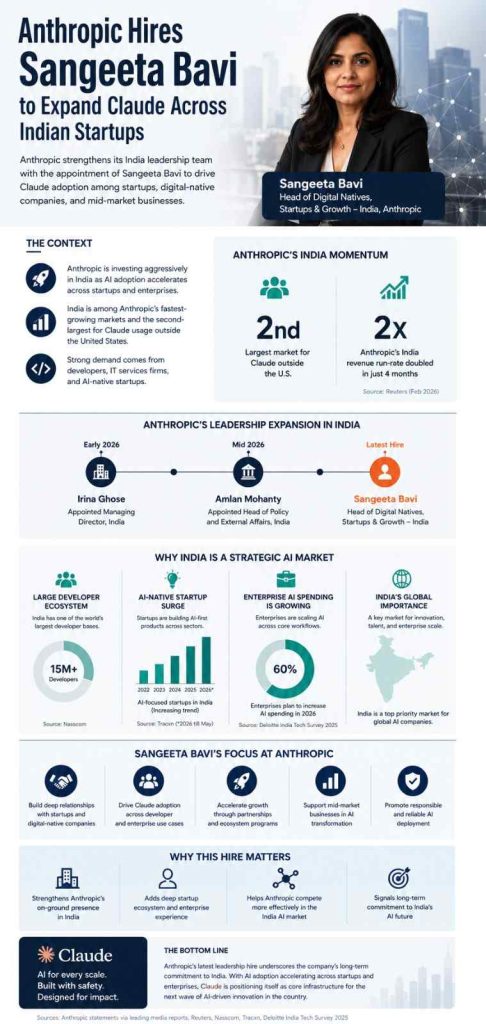
The San Francisco-based company has appointed Sangeeta Bavi as Head of Digital Natives, Startups and Growth for India, a move that reflects the increasing importance of India in Anthropic’s global expansion strategy. Her mandate will focus on accelerating adoption of Claude — Anthropic’s flagship AI assistant and developer platform — among Indian startups and mid-market businesses.
The appointment comes at a pivotal moment for India’s AI market. Over the past year, India has evolved from being a large consumer internet market into one of the world’s most active AI application ecosystems, with startups rapidly integrating generative AI into software development, customer operations, fintech workflows, healthcare, education, and enterprise automation.
For Anthropic, the opportunity is no longer theoretical. The company has repeatedly identified India as one of its fastest-growing markets globally. According to company statements reported earlier this year, India is now Anthropic’s second-largest market for Claude usage outside the United States.
Why Sangeeta Bavi Matters to Anthropic’s India Ambitions
Bavi’s appointment is significant not merely because of her experience, but because of the ecosystem relationships she brings.
Before joining Anthropic, Bavi served as COO at YourStory, where she worked closely with founders, investors, and emerging technology companies. Prior to that, she spent more than a decade at Microsoft, including leading startup business initiatives and digital-native partnerships in India.
That background gives Anthropic something increasingly valuable in India’s AI market: executive leadership with deep founder-network credibility and enterprise technology experience.
India’s startup ecosystem is currently navigating a major platform transition toward AI-native software. Startups are no longer experimenting with AI solely as a productivity layer; many are redesigning products, workflows, and customer experiences around large language models.
Anthropic appears to be positioning Claude as infrastructure for that transition.
In a LinkedIn post cited by multiple publications, Bavi described founders as central to her professional journey and said the role felt “deeply meaningful.”
Her appointment also follows a broader pattern of senior leadership hiring by Anthropic in India. Earlier this year, the company named former Microsoft India executive Irina Ghose as Managing Director for India. It also appointed former Google policy executive Amlan Mohanty to oversee policy and external affairs.
Together, the hires indicate that Anthropic is building a long-term India operation rather than treating the country as a secondary sales market.
India Has Become Central to the Global AI Expansion Race
Anthropic’s India push mirrors a broader strategic shift underway across the global AI industry.
Over the past 18 months, nearly every major frontier AI company — including OpenAI, Google DeepMind, Microsoft Azure AI, and Perplexity AI — has expanded operations, partnerships, or developer outreach programs in India.
Several structural factors are driving this surge:
1. India’s Massive Developer Base
India remains one of the world’s largest software developer markets. For AI companies, this translates into rapid experimentation, API adoption, and agent-building activity.
Anthropic executives have previously highlighted that a significant share of Claude usage in India is tied to technical workloads such as coding, mathematical reasoning, software modernization, and application development.
This matters because enterprise AI adoption increasingly depends on developer ecosystems rather than purely consumer chatbot usage.
2. AI-Native Startup Formation Is Accelerating
Indian startups are integrating generative AI earlier in their lifecycle than previous technology waves.
Instead of building SaaS tools first and layering AI later, many new startups are being designed around AI copilots, AI agents, automation pipelines, and model orchestration from day one.
This creates demand not only for AI models, but also for inference infrastructure, developer tooling, safety layers, fine-tuning capabilities, and enterprise reliability — areas where Anthropic is positioning Claude aggressively.
3. Enterprise AI Spending Is Expanding
India’s large IT services industry and enterprise technology market have become critical growth engines for frontier AI providers.
Reuters reported earlier this year that Anthropic’s India revenue run-rate had doubled within four months, driven heavily by Claude’s coding-focused enterprise adoption.
The company has already announced partnerships spanning enterprise software modernization, education, agriculture, and AI deployment initiatives in India.
Claude’s Positioning in India Is Different From Consumer AI Chatbots
Anthropic’s India strategy appears notably more enterprise-focused than purely consumer-oriented.
Unlike some rivals that prioritize mass chatbot adoption, Anthropic has leaned heavily into coding assistants, enterprise AI reliability, AI safety positioning, and developer productivity tooling.
That approach may resonate particularly well with Indian startups and IT firms that require:
- secure enterprise deployments
- workflow automation
- code generation
- AI-powered support systems
- compliance-conscious AI infrastructure
- scalable API access
Claude’s growing popularity among developers could also help Anthropic differentiate itself in a crowded market where consumer AI products are becoming increasingly commoditized.
Industry analysts note that India’s next wave of AI spending may not be driven primarily by casual chatbot users, but by businesses integrating AI into operational systems.
That includes:
- fintech underwriting
- healthcare documentation
- enterprise customer support
- legal automation
- internal coding assistants
- multilingual business workflows
Anthropic’s emphasis on “responsible AI” and safety may also help the company position itself favorably among larger regulated enterprises.
The Bengaluru Expansion Signals Long-Term Commitment
Anthropic’s India ambitions are no longer limited to remote operations.
The company formally opened its Bengaluru office earlier this year as part of a broader Asia-Pacific expansion strategy.
The move is strategically important for several reasons:
Local Enterprise Engagement
AI adoption in India often requires hands-on integration support, partner ecosystems, and local business development teams.
A physical India presence allows Anthropic to compete more effectively against companies already deeply embedded in enterprise procurement and cloud ecosystems.
Talent Acquisition
India offers one of the world’s deepest AI engineering and developer talent pools.
Anthropic’s expansion could help it recruit researchers, engineers, product specialists, policy professionals, and enterprise AI consultants locally.
Regulatory and Policy Alignment
As India develops its AI governance frameworks, companies with local policy leadership may gain advantages in enterprise trust and government engagement.
Anthropic’s policy hires suggest the company is preparing for a more regulated AI environment globally and locally.
The Competitive Landscape Is Intensifying
Anthropic’s expansion also highlights how competitive India’s AI market has become.
OpenAI continues to expand ChatGPT adoption and API partnerships. Google is integrating Gemini across enterprise and consumer ecosystems. Microsoft retains a strong enterprise distribution advantage through Azure and Copilot integrations.
Meanwhile, Indian startups themselves are beginning to develop domain-specific AI layers on top of frontier models.
The result is a new AI stack economy where value increasingly shifts toward:
- workflow integration
- enterprise customization
- industry-specific AI applications
- agent orchestration
- vertical AI products
In that environment, ecosystem relationships matter as much as raw model performance.
That is likely one reason Anthropic recruited executives with strong startup and enterprise networks rather than relying solely on technical leadership.
What This Means for Indian Startups
For Indian founders, Anthropic’s expansion could create broader access to:
- enterprise AI partnerships
- startup-focused GTM programs
- developer tooling
- AI infrastructure support
- API ecosystem collaboration
- AI education and enablement initiatives
It could also increase competition among frontier AI providers for startup mindshare.
Historically, cloud providers used startup credits, incubator partnerships, and ecosystem programs to win early-stage companies. AI firms are now beginning to replicate that playbook around foundation models and agent infrastructure.
The next major competitive battle may not be consumer AI subscriptions, but which model ecosystem becomes foundational to the next generation of startups.
The Larger Strategic Signal
Anthropic’s latest India hire is ultimately about more than regional expansion.
It reflects a broader industry realization that India is evolving into:
- a large AI consumption market
- a global developer hub
- an enterprise AI deployment center
- a testing ground for AI-enabled business models
For global AI companies, succeeding in India increasingly requires more than API availability. It requires local leadership, ecosystem engagement, policy relationships, startup partnerships, and long-term operational investment.
Anthropic’s hiring strategy suggests the company understands that shift.
Whether Claude can become a dominant enterprise AI platform in India remains uncertain in a market crowded with well-funded rivals. But Anthropic’s recent moves indicate that the company intends to compete aggressively for that position.
And increasingly, India is becoming one of the most important arenas in the global AI platform race.
Also Read : Prime Venture, Leo Capital Back Biotech Startup StrainX in $13 Million Round
Add Startup Times as a preferred Source on Google – Click Here
Last Updated on Friday, May 29, 2026 7:45 pm by Startup Times
About The Author