
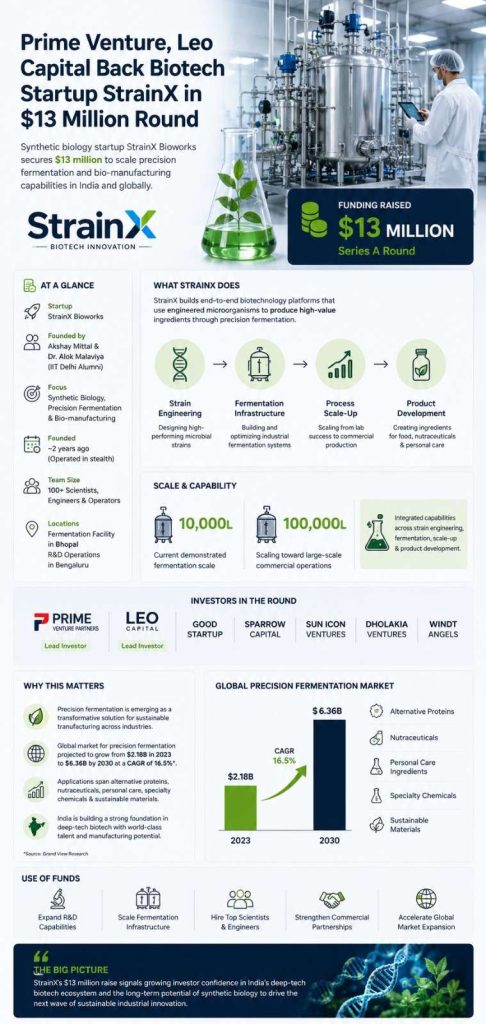
India’s deep-tech and biotechnology ecosystem is witnessing renewed investor interest as synthetic biology startup StrainX Bioworks has raised $13 million in a funding round led by Prime Venture Partners and Leo Capital.
The round also saw participation from Good Startup, Sparrow Capital, Sun Icon Ventures, Dholakia Ventures, and WindT Angels, according to company statements and multiple media reports.
The investment marks one of the more notable early-stage funding rounds in India’s emerging synthetic biology and precision fermentation sector — an area increasingly viewed as strategically important for the future of food, materials, nutraceuticals, and industrial manufacturing.
Founded by IIT Delhi alumni Akshay Mittal and Dr. Alok Malaviya, StrainX Bioworks has spent nearly two years in stealth mode building biotechnology infrastructure, strain engineering capabilities, and fermentation systems before publicly announcing its operations.
Why StrainX Matters in India’s Deep-Tech Landscape
Unlike many software-led startups that dominate India’s venture ecosystem, StrainX operates in a capital-intensive segment that combines synthetic biology, microbial engineering, and industrial-scale fermentation.
The startup is developing biological manufacturing systems that can potentially replace conventional chemical or agricultural production methods for certain ingredients and materials. This approach, commonly referred to as precision fermentation, uses engineered microorganisms to produce compounds traditionally sourced from animals, plants, or petrochemicals.
Globally, precision fermentation has attracted growing investor attention as food, climate, and supply-chain concerns push industries toward alternative manufacturing technologies.
Applications span multiple industries, including:
- Alternative proteins
- Nutraceutical ingredients
- Personal care compounds
- Specialty chemicals
- Sustainable materials
- Consumer health products
Industry analysts increasingly see biological manufacturing as a long-term industrial shift comparable to the rise of semiconductor manufacturing or cloud infrastructure — albeit still in relatively early stages commercially.
What StrainX Has Built So Far
According to the company, StrainX has already demonstrated fermentation capabilities at the 10,000-litre scale and is now working toward significantly larger 100,000-litre-scale operations.
The startup reportedly operates a fermentation facility in Bhopal and maintains research operations in Bengaluru.
During its stealth phase, the company says it built an integrated platform covering:
Strain Engineering
Designing and modifying microbial strains capable of producing specific biological compounds efficiently.
Fermentation Infrastructure
Scaling laboratory research into industrial production systems.
Process Scale-Up
One of the most difficult challenges in biotechnology, where processes successful in small reactors must be replicated reliably at commercial volumes.
Product Development
Creating commercially viable applications for food, personal care, and nutraceutical sectors.
The company has also expanded to a workforce of more than 100 scientists, engineers, and operators.
Investor Confidence Signals a Shift in Indian Venture Capital
The participation of firms like Prime Venture Partners and Leo Capital reflects broader changes underway in India’s venture capital market.
For years, Indian venture funding was heavily concentrated around consumer internet, fintech, and SaaS businesses. However, investors have increasingly started exploring sectors such as:
- Climate technology
- Semiconductor infrastructure
- Defence technology
- Space technology
- Biotechnology
- Advanced manufacturing
Synthetic biology, in particular, remains relatively underfunded in India compared to the United States, Europe, and China. Yet India’s combination of scientific talent, lower operating costs, and manufacturing ambitions is making the sector increasingly attractive.
Good Startup’s participation is especially notable because the fund is known for backing biology-focused technology companies globally, and this reportedly marks its first India investment.
The Global Precision Fermentation Opportunity
The timing of StrainX’s funding round coincides with rising global interest in alternative manufacturing systems driven by sustainability concerns and supply-chain resilience.
Precision fermentation has emerged as a key technology in areas such as:
- Dairy alternatives
- Functional proteins
- Enzyme manufacturing
- Biodegradable materials
- Sustainable cosmetics ingredients
While enthusiasm around alternative proteins cooled globally after the post-pandemic funding surge of 2020–2022, investors continue to show interest in enabling infrastructure and platform technologies rather than consumer-facing food brands alone.
That distinction is important.
Instead of competing directly as a packaged food company, StrainX appears focused on becoming a biotechnology platform and manufacturing layer that can supply ingredients and compounds to global businesses.
This infrastructure-oriented approach could potentially offer more defensible economics over the long term if the company successfully scales production.
The Challenge: Scaling Biology Is Expensive
Despite the optimism surrounding synthetic biology, the sector remains operationally complex and capital intensive.
Building commercial fermentation infrastructure requires:
- Specialized equipment
- Process engineering expertise
- Regulatory compliance
- Long development cycles
- Significant energy and operational costs
Many biotechnology startups globally have struggled to move from pilot-scale success to profitable industrial-scale manufacturing.
This makes scale-up execution one of the most important risks for companies like StrainX.
The company’s focus on integrated infrastructure — from strain engineering to manufacturing — suggests it is attempting to control more of the value chain internally rather than relying entirely on external production partners.
That strategy could improve process optimization but also increases operational complexity and capital requirements.
India’s Biotechnology Policy Push
The funding also aligns with broader policy efforts by the Indian government to strengthen advanced manufacturing and biotechnology capabilities.
India has increasingly positioned biotechnology as part of its larger deep-tech and innovation agenda, particularly in:
- Bio-manufacturing
- Sustainable chemicals
- Food security
- Healthcare innovation
- Climate resilience
The country already possesses strong pharmaceutical manufacturing infrastructure and a large scientific talent base. Investors believe similar capabilities could eventually support broader biological manufacturing ecosystems.
However, India still lags behind countries such as the United States and China in terms of large-scale synthetic biology infrastructure, specialized venture funding, and commercialization pipelines.
Funding rounds like StrainX’s therefore represent an early but important signal of ecosystem development.
What the Funding Will Likely Support
According to company disclosures, the fresh capital will primarily be used for:
- Expanding R&D capabilities
- Scaling fermentation infrastructure
- Hiring additional scientists and engineers
- Strengthening commercial partnerships
- Accelerating global market expansion
The company is targeting applications across food, nutraceuticals, and personal care markets.
Commercial partnerships will likely be critical because precision fermentation businesses often depend on long-term enterprise supply agreements rather than rapid consumer adoption cycles.
A Broader Deep-Tech Trend Is Emerging
StrainX’s funding round also reflects a wider transition underway in Indian startup funding.
After years dominated by quick-scaling internet businesses, investors are increasingly willing to back technically complex sectors that require longer gestation periods but could create foundational industrial capabilities.
Recent funding activity across semiconductor design, EV infrastructure, climate technology, and biotech suggests India’s venture ecosystem is gradually becoming more diversified.
The challenge for many deep-tech startups, however, remains balancing scientific ambition with commercial execution.
Investors backing StrainX appear to believe the startup has the potential to bridge that gap.
Outlook: Can India Build Global Bio-Manufacturing Champions?
The larger question surrounding companies like StrainX is whether India can evolve from being primarily a software and services powerhouse into a global hub for advanced biological manufacturing.
That transition would require:
- More patient capital
- Stronger industrial infrastructure
- Regulatory clarity
- Specialized talent pipelines
- Commercial-scale manufacturing ecosystems
StrainX’s emergence from stealth with a sizable early-stage round suggests at least some investors believe the opportunity is real.
Whether the company can successfully scale from pilot operations into globally competitive manufacturing will likely determine whether it becomes another experimental biotech startup — or one of India’s first large-scale synthetic biology success stories.
Also Read : Can India Build Global AI Products Without Owning Core Models?
Add Startup Times as a preferred Source on Google – Click Here
Last Updated on Tuesday, May 26, 2026 11:14 am by Startup Times
About The Author